hanip.me
Cheongpo-muk
청포묵
A cold side dish of clear white jelly set from mung bean starch, seasoned with soy sauce and vinegar.
Before the first bite
- Spice
- Not spicy
- Texture
- Soft
- Serving
- Usually shared
Varies by restaurantColored with gardenia it becomes yellow hwangpo-muk, and it is also tossed with beef and vegetables to make tangpyeong-chae. For dietary restrictions or allergies, ask the restaurant whether the food contains your trigger ingredients.
Hanip treats cheongpomuk as a challenge food. Reading this guide does not make it appear in ordinary recommendations.
Taste and texture
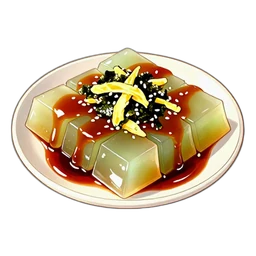
Cheongpomuk is jelly made by cooking mung bean starch with water and allowing it to set. Usually whitish and translucent, it is cut and seasoned, mixed with seaweed or used as the base of tangpyeongchae. Before seasoning, its main contribution is a smooth, soft texture rather than a strong flavor. Pastes, oils and vegetables add flavor to the plated jelly.
The powder used is mung bean starch, distinct from whole ground mung bean flour. Maangchi begins with starch and water. A Gyeongnam regional recipe in the Korean Traditional Knowledge Portal instead peels and grinds beans, strains them finely, lets the starch settle and pours off the water above. The sediment becomes the jelly base, unlike bean batter used directly for pancakes.
The starch mixture is stirred while heating to prevent sticking. The thin liquid thickens and becomes translucent before going into a mold. Some recipes add a little salt. The cooked mixture cools in rectangular containers or molds until it holds its shape, changing from suspended powder to a thick cooked mixture and finally a sliceable block.
Set jelly can be cut into sticks or broad slices. Sticks combine with slender vegetables such as minari and sprouts; broad pieces can be laid on a plate and topped with sauce. Another method sets bite-size pieces in small silicone molds. Once unmolded, they are topped with seaweed, sesame seeds and sauce, retaining their molded shapes.
A seaweed version uses relatively few ingredients. Kimjju blanches and cools cut jelly, lightly mixes it with soy sauce, perilla oil, salt, sugar and sesame seeds, then adds crushed seasoned seaweed. Dark seaweed flakes cling to the jelly and perilla oil adds aroma. This coats the pieces with seasoning without a separate thick sauce.
Vegetable versions can include mung bean sprouts and minari. Semie Kitchen blanches, cools and squeezes the sprouts, separately blanches and cools the jelly, then combines them with raw minari. Yondu, a fermented soybean seasoning, sesame oil, sesame seeds and seaweed complete it. Suggested alternatives to minari include perilla leaves, lettuce and chamnamul. Stems add bite and leaves add aroma to the soft jelly.
Tangpyeongchae combines the jelly with other ingredients. The Korea Tourism Organization describes stir-fried meat, mung bean jelly, blanched minari and roasted seaweed dressed with soy sauce. Meat, green vegetables and dark seaweed appear among the white jelly. It contains more substantial additions than sliced jelly with sauce alone; these are useful components to check on a tangpyeongchae menu.
A regional version colors the jelly with gardenia water. The Gyeongnam record in the Korean Traditional Knowledge Portal cooks settled mung bean starch with pale gardenia water and cools it in a square mold lined with damp cloth. This Gyeongnam preparation adds gardenia color to the molded mung bean jelly.
Set jelly can also be pan-fried as jeon. Menupan lightly salts broad slices, coats them with starch and beaten egg, and fries them with rock-ear mushroom and minari leaf garnishes. Vinegar-soy dip is served alongside. Instead of dressing the jelly directly, this preparation adds a cooked egg layer around its exterior.
The jelly is soft and smooth, with a gentle springiness. Its mild flavor allows roasted seaweed and perilla or sesame oil to stand out. Soy sauce adds saltiness, while vinegar-based dressing brings tang. Some soy dressings include honey or sugar. Gentle mixing keeps the pieces intact with seasoning and seaweed flakes on their smooth surfaces.
Sprouts and minari add crisp stems among the soft jelly; perilla leaves or crown daisy contribute pronounced leafy aromas. Meat in tangpyeongchae provides a separate chewy component. Egg-coated jeon retains a soft jelly interior with a fried outer coating. The accompanying ingredients and cooked exterior add different textures to the mung bean jelly base.
When it may suit the table
- When you want a mildly flavored side dish.
- You're in the mood for a cold, soft texture
When another path may fit better
- You want a dish with a pronounced flavor of its own
- You need something more filling
How to order it in Korea
- Look for “cheongpomuk” or “cheongpomuk-muchim” on the menu; it may also be written as nokdu-muk.
- Ask whether it comes as tangpyeongchae, which tells you if beef and vegetables are mixed in.
Show the Korean nameName and a short phrase
Use this to point out the food or say its name. Check the food-specific ordering tips above first.
청포묵
Save, share or print an image
More guides in this category
Checked sources
Reviewed 2026-08-25 · Next check 2027-03-31
- Wikipedia Opens in a new tab.
- Food Safety Korea Opens in a new tab.
- Korean Food Promotion Institute (Hansik.or.kr) Opens in a new tab.
- Maangchi Opens in a new tab.
- Sempio / Semie Kitchen Opens in a new tab.
- Korean Traditional Knowledge Portal / Rural Development Administration Opens in a new tab.
- 10000 Recipe Opens in a new tab.
- VISITKOREA Opens in a new tab.
- Menupan Opens in a new tab.