hanip.me
Jang-jorim
장조림
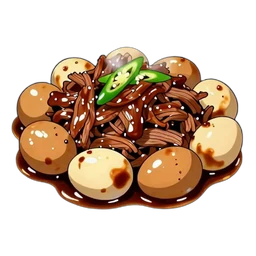
A savory Korean side dish of lean beef braised in soy sauce with boiled eggs or quail eggs.
Before the first bite
- Spice
- Not spicy
- Texture
- Tender · Chewy
- Serving
- Individual or shared
Varies by restaurantSome kitchens use hard-boiled hen eggs instead of quail eggs, or braise in mushrooms and green peppers. For dietary restrictions or allergies, ask the restaurant whether the food contains your trigger ingredients.
Hanip treats jangjorim as a challenge food. Reading this guide does not make it appear in ordinary recommendations.
Taste and texture
Jangjorim is lean meat braised in soy sauce, sometimes with eggs, quail eggs or shishito peppers. Meat may be cooked in blocks and shredded, or cut into strips before braising. Brown meat and sauce share the dish, with garlic or eggs adding other shapes. Small portions accompany rice.
Wtable specifies beef eye round or top round; Korean Bapsang also uses brisket, flank or shank. The grain gives shredded jangjorim its form: cooked blocks separate lengthwise into slender strands, unlike a patty made from minced meat.
Some recipes separate initial cooking from soy braising. Korean Bapsang first cooks beef in water with onion, scallion, radish, garlic, ginger and pepper. The liquid is strained and partly reused for braising with soy sauce and sweet seasoning, so the meat softens in aromatic broth first.
Cooking-liquid treatment varies. Wtable discards the water used to cook beef with scallion, garlic, onion and peppercorns and lists separate water, soy sauce, cooking wine and sugar for braising. Maangchi's beef-focused recipe discards an initial boil, cooks the beef again in water, then adds soy sauce, garlic, onion and chili.
Sweetness can come from different ingredients. Korean Bapsang combines regular and soup soy sauces with sugar and rice wine; Maangchi's beef-focused version uses onion for sweetness. Her separate egg-and-pepper version adds honey and kelp. Cooked onion or sweeteners contribute alongside the salty soy seasoning.
Shishito peppers and garlic remain as edible pieces. Wtable removes pepper stems and pierces the peppers. Semie allows whole or cut peppers and whole or halved garlic. Wrinkled peppers and rounded garlic sit among meat strands and lend their aromas to the sauce.
Peeled boiled eggs can be added after the meat has braised, as in Korean Bapsang's recipe. Quail eggs offer smaller soy-colored pieces. Semie's quail-egg version combines cooked eggs, its branded braising sauce, water, peppers and garlic without meat.
Semie's one-pan version cuts beef into narrow strips and combines it with peppers, garlic, its branded jangjorim sauce and water. Tenderloin, eye round or top round are suggested. This particular prepared-sauce recipe sets the small meat shape before cooking rather than shredding a large cooked block.
Pork versions can use lean tenderloin or loin. Moon Sung-sil cooks tenderloin in water with doenjang, pepper, scallion, garlic and ginger, then cools and shreds it, removing fat and sinew. It is braised again with soy sauce, rice wines, dark sugar and starch syrup; optional Cheongyang chili adds heat.
Wtable's butter jangjorim rice combines shredded meat, braising liquid, butter, scrambled eggs, pickled radish and thin scallion. Meat strands mix with soft eggs and rice, with crunchy radish. Maangchi also suggests mixing braising liquid into warm rice or wrapping that rice in gim.
Soy seasoning is salty and subtly sweet, and the meat retains its grain. Shredded pieces separate into fibers as they are chewed, while pre-cut strips retain more thickness. The surface is moist with braising liquid rather than a crisp grilled crust.
Garlic and peppers also absorb the sauce. Garlic softens and peppers add aroma. A cut egg shows white and yolk beneath a soy-colored exterior; springy white and crumbly yolk differ from shredded meat.
Add sauce to rice in small amounts as its salt can be immediately apparent. Butter and egg make the rice richer and softer, while chili can add heat. An egg-heavy serving centers on soft eggs; a meat-heavy one centers on fibrous lean meat.
When it may suit the table
- You want a savory side dish to eat with rice
- You're looking for a side dish that travels well in a lunch box
When another path may fit better
- You'd rather have a vegetable side dish than meat
- You want something spicy and bold
How to order it in Korea
- Look for “jangjorim” on the menu or side-dish list; it also shows up in convenience store lunch sections.
- Ask whether it comes with hard-boiled eggs or quail eggs.
Show the Korean nameName and a short phrase
Use this to point out the food or say its name. Check the food-specific ordering tips above first.
장조림
Save, share or print an image
More guides in this category
Checked sources
Reviewed 2026-08-25 · Next check 2027-04-07
- Wikipedia Opens in a new tab.
- Namu.wiki Opens in a new tab.
- Food Safety Korea Opens in a new tab.
- Korean Food Promotion Institute (Hansik.or.kr) Opens in a new tab.
- Korean Bapsang Opens in a new tab.
- Maangchi Opens in a new tab.
- Wtable Opens in a new tab.
- Semie Kitchen Opens in a new tab.
- 10000 Recipe Opens in a new tab.