hanip.me
Braised cutlassfish
갈치조림
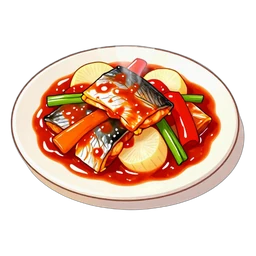
A sweet and spicy braise of cutlassfish and radish simmered under a red chili seasoning.
Before the first bite
- Spice
- Medium
- Texture
- Soft · Tender
- Bones
- Usually bone-in
- Serving
- Individual or shared
Varies by restaurantIngredients other than radish are sometimes added, and the heat of the red chili seasoning varies by restaurant. For dietary restrictions or allergies, ask the restaurant whether the food contains your trigger ingredients.
Hanip treats Galchi-jorim as a challenge food. Reading this guide does not make it appear in ordinary recommendations.
Taste and texture
Galchi jorim braises cutlassfish pieces with radish and chili seasoning. Unlike salt-grilled galchi, the sauce seasons both fish and vegetables. Tender fish, seasoned radish and a little braising liquid accompany rice. The long, flat fish is cut crosswise, leaving broad sections with a central bone.
Preparation removes the head, innards and fins before portioning the body. Maangchi removes remaining innards and the dark inner membrane and pats the fish dry; Semie Kitchen also trims fins and tail. The flat portions retain flesh and bones, which still need separating after braising.
Radish forms a layer under the fish. Maangchi puts onion over half-moon radish slices and places fish side by side above them. Seasoning goes on the fish and water is poured around the edge. Spooning liquid over the top seasons the delicate fish while the lower vegetables cook in the sauce.
Semie Kitchen cooks thick radish slices first, adds potato once the radish becomes somewhat translucent, then adds fish, seasoning, onion, scallion and chili. This softens firm root vegetables before joining them with fish, using a separate vegetable-cooking stage.
Potato can replace radish as the main lower layer. W Table arranges onion, sliced potato and fish, then adds kelp broth and seasoning with soy sauce, chili, cooking wine, garlic, ginger juice and sugar. Potato becomes fluffy and breaks apart, compared with the more watery softness of radish.
Wansoyeonhong combines small whole potatoes with radish in an earthenware pot. Fish and vegetables cook with water, soy sauce, gochujang, chili flakes, cooking wine and pepper. Kelp is added and later removed, with scallion at the finish. Rounded whole potatoes remain beside the fish instead of thin potato slices.
A siraegi version uses cooked greens as the base. Chic J Mom dresses cut, boiled greens with perilla oil and soup soy sauce, adds fish, and coats it with chili flakes, soy sauce, sand-lance fish sauce, garlic, sugar and rice wine. Water or stock is added, with scallion and red chili at the end. Leaves and stems hold the sauce beneath the fish.
Sweetness can come from different ingredients. Maangchi uses more onion instead of added sugar, while Semie Kitchen and W Table include sugar. Some sauces use gochujang as well as soy sauce and chili flakes. Cooked onion, sugar and the paste itself contribute different components to the red seasoning.
Cooked galchi is fragile. Maangchi recommends leaving the pieces in place and spooning sauce over them rather than repeatedly moving or turning them. The siraegi version also bastes with broth. Fish and vegetables keep their shapes instead of being vigorously stirred together, and tender fish can be served with the vegetables beneath it.
The flesh is delicate and the seasoning sweet and spicy. Pale fish separates along its flakes with red sauce clinging to the surface. Chili, garlic, ginger and scallion give the liquid a distinct aroma. Unlike crisp grilled fish, braised flesh remains moist. Remove the bones before eating it with rice.
Well-cooked radish absorbs liquid and is easy to divide with a spoon. Onion softens into long pieces, potato breaks into fluffy sections, and siraegi leaves and stems remain alongside the fish. Vegetables cooked underneath and their seasoning are a substantial part of the dish.
A little sauce collects between the fish and vegetables, combining soy saltiness and chili heat. It can be spooned over fish or eaten with radish and rice. Gochujang or fish sauce adds fermented-seasoning flavor where used. Radish, potato and siraegi each give a different vegetable texture.
When it may suit the table
- When you want fish with radish that has absorbed the braising sauce.
- When you want spicy fish alongside rice.
When another path may fit better
- You need a mild fish dish without chili heat
- Picking bones out of fish feels like too much work
How to order it in Korea
- Look for “galchi-jorim” on the menu and order it separately from “galchigui,” the salt-grilled version.
- Radish cooks beneath or alongside the fish, soaking up the seasoning. Well-cooked radish gives a different soft texture from the fish itself. If you want both, check that radish is included, and add the braising sauce to rice a little at a time.
Show the Korean nameName and a short phrase
Use this to point out the food or say its name. Check the food-specific ordering tips above first.
갈치조림
Save, share or print an image
More guides in this category
Checked sources
Reviewed 2026-09-13 · Next check 2027-04-07