hanip.me
Gosari-namul
고사리나물
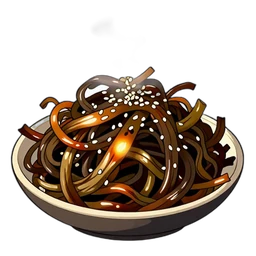
Gosari-namul is a Korean side dish of bracken that is soaked, parboiled and then stir-fried with seasoning.
Before the first bite
- Spice
- Not spicy
- Texture
- Tender · Chewy
- Serving
- Usually shared
Varies by restaurantNamul can be seasoned with salt, vinegar, sesame or perilla oil and soy sauce, so the seasoning differs from cook to cook. For dietary restrictions or allergies, ask the restaurant whether the food contains your trigger ingredients.
Hanip treats gosari-namul as a challenge food. Reading this guide does not make it appear in ordinary recommendations.
Taste and texture
Gosari namul is prepared, cooked bracken seasoned and stir-fried, sometimes starting from dried bracken. Its brown, slender stems overlap on the plate after being cut into manageable lengths. The tender, resilient stems are central to its texture. Soy seasoning and perilla or sesame oil make it a savory companion to rice.
Young shoots and stems are used. Bracken comes dried or already cooked; dried bracken is softened by soaking and boiling. My Korean Kitchen also describes cooked frozen products. Before stir-frying, woody sections are discarded and stems cut to length. The stems retain their form rather than being ground.
Some recipes season the stems before frying. Wtable uses soup soy sauce, chopped scallion, garlic, perilla oil and pepper, mixing them through the prepared bracken. Korean Bapsang likewise mixes soy sauce, garlic and sugar first, then stir-fries with oil and finishes with scallion, sesame oil and sesame seeds.
Water or stock can be added during cooking. Korean Bapsang offers water, kelp stock or beef broth; My Korean Kitchen adds a little water after frying. Wtable lists anchovy-kelp stock or water. A dish that visibly consists of stems can therefore contain meat or fish stock. Vegetarians should check the broth as well.
Paik Jong Won starts by frying chopped scallion in perilla oil, followed by garlic and hydrated bracken. Rice-rinsing water, soup soy sauce, brown sugar and salt are added and reduced, with ground sesame to finish. Here the aromatics cook in oil before the stems are added.
Maangchi presents a version learned from nun Wonhae at Goun Temple in Uiseong without scallion or garlic. Softened bracken is seasoned with soy sauce and perilla oil, gently fried in vegetable oil without breaking the stems, then finished off the heat with sesame oil and ground sesame. The oils and seeds supply nutty aroma.
A Dongwon Mall contributor's perilla version seasons cooked bracken with soup soy sauce, garlic and perilla oil, then fries it with scallion and ground perilla. Shiitake-kelp water is added before covered cooking. Ground seeds remain among the moist stems, unlike a thin coating of soy sauce and oil.
The Korean Traditional Knowledge Portal records a Jeollabuk-do version using ground perilla and rice flour. Bracken is fried with soy sauce, scallion and garlic, then boiled with water containing the ground ingredients. The stems are combined with a perilla-rice mixture, rather than simply finished with oil or a sprinkling of powder.
Gosari supplies brown in three-color namul, alongside white bellflower root and green spinach. Korean Bapsang also describes using radish for white. Slender brown stems, pale roots or radish and green spinach leaves are prepared and seasoned separately before being arranged together.
In bibimbap, seasoned gosari joins other vegetables over rice. Its stems add chew among the rice grains, while gochujang brings chili seasoning to the soy-seasoned vegetables. As a separate side, bracken and rice can be eaten in alternating bites. Gosari is also used in yukgaejang, but gosari namul is finished as a stir-fried side.
Oil and soy seasoning are nutty and salty, while the softened stems retain chew. The flexible stems have a fine fibrous bite rather than the thin softness of leaves. Seasoning gives their surface a sheen while the bracken retains an earthy aroma.
Perilla or sesame oil adds roasted-seed richness. Garlic and scallion bring aromatics, and ground or whole sesame supplies small particles among the stems. Versions with ground perilla and stock include a moist coating, combining long stems with chopped aromatics and ground seeds.
When it may suit the table
- You want a plain vegetable side dish to eat with rice
- You're curious about the greens that go on top of bibimbap
When another path may fit better
- Wild mountain greens still feel unfamiliar to you
- You need one filling main dish rather than a small side
How to order it in Korea
- Look for “gosari-namul,” and since a Korean set-meal restaurant may serve it as one of the shared banchan, ask which side dishes come with the meal.
- Gosari is a typical bibimbap topping, so ordering bibimbap is another way to try it alongside other greens.
Show the Korean nameName and a short phrase
Use this to point out the food or say its name. Check the food-specific ordering tips above first.
고사리나물
Save, share or print an image
More guides in this category
Checked sources
Reviewed 2026-08-25 · Next check 2027-04-07
- Wikipedia Opens in a new tab.
- Namu.wiki Opens in a new tab.
- VISITKOREA Opens in a new tab.
- Korean Food Promotion Institute (Hansik.or.kr) Opens in a new tab.
- Food Safety Korea Opens in a new tab.
- Korean Bapsang Opens in a new tab.
- My Korean Kitchen Opens in a new tab.
- Maangchi Opens in a new tab.
- Wtable Opens in a new tab.
- Paik Jong Won Opens in a new tab.
- Korean Traditional Knowledge Portal · Rural Development Administration Opens in a new tab.
- Dongwon Mall · lov*** Opens in a new tab.