hanip.me
Ojingeo-bokkeum
오징어볶음
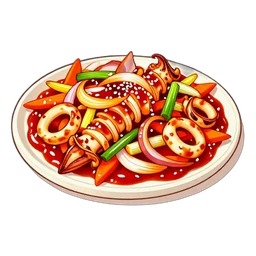
Cleaned squid cut into bite-sized pieces and stir-fried with vegetables in a spicy seasoning.
Before the first bite
- Spice
- Hot
- Texture
- Chewy · Mixed textures
Varies by restaurantThe vegetables in the stir-fry and the heat of the seasoning vary by restaurant. For dietary restrictions or allergies, ask the restaurant whether the food contains your trigger ingredients.
Hanip treats ojingeo bokkeum as a challenge food. Reading this guide does not make it appear in ordinary recommendations.
Taste and texture
Ojingeo-bokkeum combines bite-size squid and vegetables in red seasoning. Broad mantle pieces and slender tentacles share a plate with vegetables such as onion and carrot. It can be a side dish or drinking dish, or become ojingeo-deopbap over rice; the stir-fry name alone does not include rice.
The mantle can be sliced into rings or opened and cut into strips, with tentacles divided to similar lengths. Rings and flat strips differ in shape and thickness when lifted. Smooth rings and crosshatched pieces in photographs may reflect different preparation of the same ingredient.
Cleaning removes the innards and beak. Skin may be removed or retained: skin-on flesh shows some squid coloring while peeled flesh has a pale surface. Retaining skin does not by itself mean inadequate preparation. Both mantle and tentacles are used either way.
A shallow crosshatch on the inner mantle can create a pattern as it cooks and help retain sauce, but scoring is optional. Smooth rings also work. Squid shrinks and curls during cooking rather than necessarily retaining its flat raw shape.
Seasoning may combine gochujang, gochugaru, soy sauce, garlic, ginger and sweetener, or use pepper flakes and soy without gochujang. Paste contributes body, while pepper flakes and fresh chilies alter heat. Sesame oil or seeds may finish the dish.
Onion, carrot and scallion can be joined by zucchini, cabbage or bell pepper. Thin vegetable strips are convenient to pick up with squid. Some methods soften vegetables first, then add squid and sauce, finishing quickly as the flesh turns opaque and curls.
Sauce can simply coat the ingredients or be bound with a little starch slurry. That is a recipe variation, not a compulsory ingredient. A plate with some pooled liquid and one with a thicker coating can therefore both be squid stir-fries.
Chewy squid and sweet-spicy sauce lead the dish. Broad mantle pieces feel different from slender, curved tentacles. It retains springiness rather than flaking like fish; recipes stress brief cooking to avoid toughness.
Vegetables add onion sweetness, firmer carrot and softer zucchini flesh. Even under the red coating they are more than decoration: their identity and doneness shape the combined bite.
Chili heat is joined by soy saltiness and sweeteners. Garlic and ginger deepen the aroma, and sesame oil can leave a nutty finish. A sweet bite still contains chili, so sweetness and heat are not opposite ends of one scale.
Over warm rice, the sauce coats the grains and the ingredients share a spoonful. A separate serving lets you change the rice-to-squid ratio. Somyeon offers thin noodles coated with the same seasoning, a different texture from rice. Choosing rice, noodles or the stir-fry alone defines the meal even when you like the same sauce.
When it may suit the table
- You're in the mood for a spicy, sweet seasoning
- You want to enjoy the chewy texture of squid
When another path may fit better
- You'd rather avoid a spicy seasoning
- Seafood such as squid feels unfamiliar to you
How to order it in Korea
- For a rice meal, distinguish a squid stir-fry that includes rice from ojingeo-deopbap served over rice. Ojingeo-somyeon pairs the stir-fry with thin noodles to mix into the sauce. Similar seasoning can accompany rice, noodles or the stir-fry alone, so check the accompaniments.
- It's seasoned with red pepper paste and powder, so ask about the spice level when you order.
Show the Korean nameName and a short phrase
Use this to point out the food or say its name. Check the food-specific ordering tips above first.
오징어볶음
Save, share or print an image
More guides in this category
Checked sources
Reviewed 2026-09-13 · Next check 2027-03-24