hanip.me
Perilla seed kalguksu
들깨칼국수
Knife-cut wheat noodles simmered in a warm broth thickened with finely ground perilla seeds.
Before the first bite
- Spice
- Not spicy
- Texture
- Brothy · Soft
- Serving
- Usually individual
Varies by restaurantWhether the broth is built on anchovies, chicken or Manila clams, and how much perilla seed goes in, differ by restaurant. For dietary restrictions or allergies, ask the restaurant whether the food contains your trigger ingredients.
Taste and texture
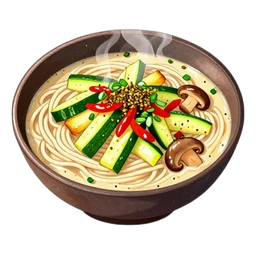
Deulkkae-kalguksu is hot knife-cut wheat noodle soup with the nutty flavor of perilla seeds. It is a meal of broad noodles and a broth to eat alongside them. Its noodles follow the kalguksu method of rolling wheat dough thin and cutting it with a knife. The warmth and consistency differ from chilled noodles or noodles mixed only with a dressing.
Perilla can enter the soup in different forms. Whole seeds may be blended with water and strained to make the broth, or ground perilla may be stirred into prepared stock near the end. One method builds the soup around perilla water; the other adds perilla to an existing stock. The particles left in the soup and the intensity of its nuttiness can therefore vary.
An RDA recipe recorded for Jeonbuk cooks noodles in perilla water, adds julienned zucchini and seasons with salt. Wheat flour, perilla and zucchini form a relatively simple composition. Perilla is a broth ingredient rather than a few decorative seeds. Even a bowl without conspicuous meat or shellfish can center on perilla aroma and soft noodles.
Kalguksu stock can use anchovies, chicken or clams. The perilla name describes a flavor added to the soup, not one fixed stock. An anchovy-stock version with perilla powder may also use soup soy sauce and fish sauce for seasoning. A pale bowl with plenty of vegetables can thus contain fish ingredients in its broth.
The cooking sequence varies too. Some recipes begin with boiling perilla water; others cook the noodles in anchovy stock before adding ground perilla. Adding the powder later separates cooking the noodles from thickening the finished soup. Dispersing it rather than leaving a lump distributes perilla through the broth and between the noodles.
Besides zucchini, kalguksu may contain potatoes or mushrooms. Cooked potato gives a floury texture, while mushrooms add pieces to chew among the noodles. One recipe juliennes king oyster mushrooms and suggests shiitake for another aroma. Vegetables may resemble the long noodles in shape, but their textures differ from the spring of wheat dough.
For a convenience variation, Nongshim presents its anchovy-kalguksu product with beaten egg, perilla powder, chili powder and dried laver. The powders garnish the egg-enriched noodles. This is a specific product adaptation; egg and chili are not ingredients in every perilla kalguksu. Depending on its toppings, an apparently mild perilla soup may include a spicy accent or soft egg.
The first impression is perilla aroma and broth coating the noodles. Rather than running off as lightly as a clear anchovy broth, the dispersed perilla clings to their surfaces. Consistency still depends on the amount of perilla and liquid. The name alone does not promise an exceptionally dense or porridge-like soup.
Kalguksu noodles have broad surfaces and bend softly. Lifted from the perilla broth, they combine coated surfaces with the chew of the noodle itself. Wheat's spring, tender zucchini and chewy mushrooms can appear in the same bowl. A uniformly nutty broth does not make every solid ingredient feel alike.
Laver, chives, scallions and sesame seeds also contribute when used as toppings. Laver brings a marine aroma, chives or scallions an allium note, and sesame another nutty layer. Chili powder can give a spicy accent to the mild base. The finishing ingredients change the aroma of a mouthful even when the underlying broth is similar.
When it may suit the table
- You want a warm broth to settle into
- You want a nutty noodle dish without spice
When another path may fit better
- When a thick broth is not what you want and you are after a clear one to drink — the soup here is built with ground perilla, so unlike other kalguksu it does not come out clear
- You want cold noodles instead
- You are after a spicy, sauced dish
How to order it in Korea
- Look for “deulkkae kalguksu” on the menu to tell it apart from other kalguksu such as the Manila clam version.
- Perilla describes the nutty element of the soup, not a guarantee that no other stock is used. Ask whether the base is perilla water alone or includes stock from ingredients such as anchovies, chicken or shellfish. Checking toppings such as potato, zucchini or mushrooms also helps distinguish versions.
Show the Korean nameName and a short phrase
Use this to point out the food or say its name. Check the food-specific ordering tips above first.
들깨칼국수
Save, share or print an image
More guides in this category
Checked sources
Reviewed 2026-09-13 · Next check 2027-03-24