hanip.me
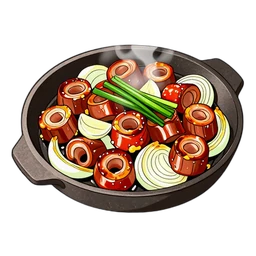
Grilled gopchang
곱창구이
Cleaned beef small intestine, simply salted or marinated, then grilled.
Before the first bite
- Spice
- Not spicy
- Texture
- Chewy · Crisp
- Bones
- None
- Serving
- Usually shared
Varies by restaurantSome places simply salt it while others marinate it, and the dips — ssamjang, curry, cheese or onion sauce — differ from shop to shop. For dietary restrictions or allergies, ask the restaurant whether the food contains your trigger ingredients.
Hanip treats gopchang-gui as a challenge food. Reading this guide does not make it appear in ordinary recommendations.
Taste and texture
This guide covers beef small intestine, cleaned, seasoned with salt or marinade and grilled. Gopchang can also mean pork small intestine, so the animal matters. It offers a springier offal bite than muscle-meat steak. Cutting the long grilled tube reveals its outer wall and the filling called gop.
Daechang and makchang are different cuts: beef daechang is large intestine, and beef makchang is the fourth stomach. Yang refers to stomach tissue, while yeomtong is heart. A mixed platter can therefore contain slender tubes, broad thick stomach pieces and meat-like heart, rather than one cut alone.
Preparation and seasoning precede grilling. KTO describes onion-juice-marinated beef gopchang and either salt or marinade seasoning. Sawol-e's home recipe trims external fat and uses an initial heating stage before grilling. The long, rounded form is turned to brown its surfaces rather than laid out like a flat steak.
Another home recipe precooks the intestines in aromatic water. Yori Toktok Mat Toktok cooks beef gopchang and makchang with scallion, scallion roots, peppercorns and garlic, then grills them in a pan. Cooking in water and browning the surface are separate stages.
KBS describes Busan yang-gopchang as an assortment named for stomach and small intestine, containing yang, daechang, gopchang, makchang and heart. The small intestine's tubular chew is joined by thicker stomach and heart textures, with differently shaped cuts sharing the grill.
Grilling surfaces vary. Home recipes use pans, while reporting from Jagalchi Market describes mesh grills over coal briquettes. Baekhwa Yanggopchang precooks offal in the kitchen before finishing it on the mesh. Heat browns the curved surfaces while the gop remains inside.
Salt-grilled versions can include aromatics and oil. The Baekhwa report describes salt, pepper, minced garlic and sesame oil, alongside a sweet, mildly spicy marinated version. A separate dip combines soy sauce, sugar and minced garlic. Seasoning applied before grilling and sauce used after cooking contribute at different stages.
Chives and onion may be dressed separately. Yori Toktok Mat Toktok combines them with seasoning including tuna extract, soy sauce, chili flakes and sesame oil for geotjeori, and also prepares an onion sauce with soy sauce, water, sugar and vinegar. Raw chive aroma, onion crunch and a tangy dip accompany the rich grilled offal.
Sawol-e instead lightly salts and pan-cooks chives, removes them, then browns and cuts the gopchang. Galbi sauce is briefly reduced in the same pan. Cooked chives surround rice, with grilled intestine and sauce on top. This rice bowl uses cooked greens rather than raw chive salad. A bulgogi-style sauce is offered as an alternative to galbi sauce.
Gopchang is rich and savory with a springy chew. Its surface browns while the filling contributes a nutty richness. The tubular wall feels different from thin muscle meat. Even in a mixed platter, its rounded cross-section and filling remain recognizable, combining a grilled exterior with the interior's flavor.
Salt-seasoned grilling adds garlic, pepper and sesame aromas to the offal. Marinated versions also carry sweetness and heat. A soy-vinegar onion dip adds salt and acidity, while raw chive salad brings a distinct aroma. Cooked chives soften and provide a different texture from the raw salad.
A mixed yang-gopchang platter varies by cut. KBS distinguishes gopchang's chewy, slightly sweet richness, daechang's fatty flavor and heart's firm chew. Thickness, shape and fat sensation change between pieces. Thin tubular intestine, thick stomach and heart pieces offer these alternating textures.
When it may suit the table
- You are after a grilled dish with a chewy bite
- You want something to go with a drink
When another path may fit better
- The distinct smell and look of offal feel unfamiliar
- You need something leaner and lighter
How to order it in Korea
- Look for “gopchang-gui” on the menu and check whether it is beef or pork intestine.
- Check whether you are ordering beef gopchang alone or a mix with daechang and makchang. Beef daechang is large intestine and beef makchang is the fourth stomach, not simply different sizes of gopchang. Check the assortment list for variety, or ask how much small intestine is included if that texture is your preference.
Show the Korean nameName and a short phrase
Use this to point out the food or say its name. Check the food-specific ordering tips above first.
곱창구이
Save, share or print an image
More guides in this category
Checked sources
Reviewed 2026-09-13 · Next check 2027-04-07