hanip.me
Jjukkumi bokkeum
쭈꾸미볶음
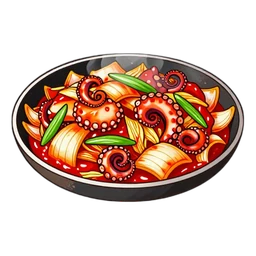
Jjukkumi bokkeum is webfoot octopus marinated and stir-fried in a spicy seasoning, known for its chewy texture and strong heat.
Before the first bite
- Spice
- Hot
- Texture
- Chewy
- Serving
- Usually shared
Varies by restaurantHow intense the spice and seasoning are can vary by restaurant. For dietary restrictions or allergies, ask the restaurant whether the food contains your trigger ingredients.
Hanip treats jjukkumi bokkeum as a challenge food. Reading this guide does not make it appear in ordinary recommendations.
Taste and texture
Jjukkumi-bokkeum is webfoot octopus stir-fried in a red, spicy sauce, served alongside or mixed into rice. Smaller than nakji, it has eight arms of relatively similar length; both cooked arms and mantle are eaten. Servings may contain cut pieces or retain the animal's outline, so the name does not specify a uniform bite size.
Preparation removes the innards, ink sac and beak, followed by washing. Some recipes rub with flour or salt before rinsing. Small specimens may be cooked whole, while larger ones are cut after blanching. The final shape therefore varies with size and preparation.
Several recipes briefly blanch the octopus before stir-frying it with sauce and vegetables. Wtable explains pre-blanching as a way to reduce excess moisture; another recipe briefly marinates the blanched octopus. Preparation and the final sauce-coating stir-fry are separate stages. The final stir-fry coats the pre-cooked octopus evenly with seasoning and brings it together with the vegetables.
Sauce combines gochujang and gochugaru with soy sauce, minced garlic and sugar or syrup. Cooking wine, ginger juice and pepper appear in some recipes, and a little curry powder is another variation. Gochujang contributes to the thick red coating, while soy and sweeteners add saltiness and sweetness. Garlic-led and sweeter versions can taste different.
Vegetables include onion, scallion, cabbage and carrot. Some methods cook onion or cabbage first, then quickly combine blanched octopus and sauce rather than simmering everything together for a long time. Fresh chilies may be added. Vegetable-heavy plates and octopus-focused plates give different proportions in each bite.
Besides serving the stir-fry separately from rice, it can form a bibimbap with bean sprouts, lettuce, fresh radish salad or flying-fish roe. A shared griddle is another format. Distinguishing the stir-fry from the assembled rice dish makes it easier to understand whether rice is separate and which accompaniments are included.
Springy, chewy octopus meets strong heat and sweet seasoning, sometimes with a grilled aroma from stir-frying. Buljukkumi particularly emphasizes heat. Sweetness does not mean mildness: both can be strong at once. The baseline here remains hot, and any selectable level follows the restaurant's own scale.
The mantle and arms differ in shape and thickness, so bites feel different. Gathered arms remain springy, while cut pieces combine flesh and sauce at their particular size. Recipes use a brief final stir-fry to avoid toughening the octopus. Its elasticity may be unsuitable if you want seafood that flakes as easily as tender fish.
Onion and cabbage add sweet, softer bites among the springy octopus. Bean sprouts and lettuce in bibimbap provide a crisper contrast, while radish salad adds its own flavor and flying-fish roe adds tiny popping grains. These accompaniments broaden the ingredients and textures rather than removing the spicy seasoning.
Jjusam adds pork belly, introducing both pork flesh and fat. Versions may include perilla, bean sprouts and cheese. Melted cheese adds stretch and richness, but the chewy octopus and red sauce remain. Octopus alone, pork-belly combinations and cheese additions are distinct ingredient choices.
Thin somyeon can accompany the stir-fry. Sauce spreads between rice grains when mixed with rice, whereas noodles contrast slender strands with springy seafood. Adding sauce in portions helps adjust seasoning instead of mixing everything at once. Whether rice or noodles are included should not be inferred from plate size.
When it may suit the table
- You want a spicy seafood stir-fry
- You want to mix a spicy stir-fry into rice
When another path may fit better
- You need to avoid strong heat or want something gentler
- A chewy seafood texture feels unappealing
How to order it in Korea
- Look for “jjukkumi bokkeum” on the menu, then ask the restaurant how hot its default version is.
- Check whether the dish is an individual meal with rice or a shared iron-plate serving. The ordering unit and inclusion of rice can differ under the same name. Look at the portion label and rice options, and ask whether a single-person portion is available.
At the restaurant
- Hot juices may remain inside the body; let it cool a little before biting.
Show the Korean nameName and a short phrase
Use this to point out the food or say its name. Check the food-specific ordering tips above first.
쭈꾸미볶음