hanip.me
Khao man gai
카오만가이
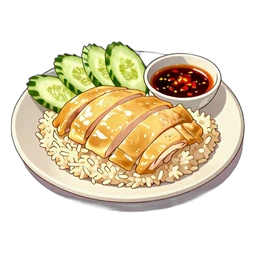
A Thai chicken and rice plate of poached chicken served over rice cooked in chicken stock and fat.
Before the first bite
- Spice
- Mild
- Texture
- Tender · Soft
- Serving
- Usually individual
Varies by restaurantThe sauce is usually built from yellow soybean paste, soy sauce, chili, ginger, garlic and vinegar, but the blend differs from shop to shop. For dietary restrictions or allergies, ask the restaurant whether the food contains your trigger ingredients.
Taste and texture
Khao man gai is the Thai name for Hainanese chicken rice, literally “chicken fat rice.” Poached or roasted chicken is served over rice cooked with chicken stock, fat, ginger and garlic.
A poached version gently cooks chicken in enough water to cover it, producing both meat and stock. It may use a whole bird or leg quarters, as in Nong’s recipe. Cooked breast can be sliced, while thigh meat is removed from the bone and cut into bites. Breast shows fine fibres; darker thigh includes softer fatty areas. Retained skin forms a smooth thin layer. Pieces spread over rice can be eaten with the grains rather than pulled from one large piece.
Chicken skin can be cooked to render its fat, with the browned crisp pieces removed before garlic is cooked in the fat. Finely chopped garlic is stirred gently to colour without burning, adding roasted rather than raw-garlic sharpness. Vegetable oil is an alternative in one recipe. Fat and aromatic garlic flavour the rice itself before any stronger dipping sauce is added to the plate.
Some formulations add pickled garlic and its brine. Nong’s combines fermented soybeans, ginger, garlic, light and sweet dark soy sauces, vinegar, syrup and chili. Another recipe loosens overly thick or salty sauce with chicken broth, making it spread more readily over rice and meat. Chunkier mixtures remain thicker on the chicken. Rice vinegar with lime, white vinegar, and garlic pickle brine provide different sources of acidity and aroma across recipes.
The accompanying soup can use remaining poaching stock with peeled, seeded winter melon simmered in pieces. Daikon or plain broth are alternatives. One method skims surface fat and seasons with salt and pepper, distinct from the fatty garlic rice. Nong’s soup formulation includes soy sauce, white pepper, cilantro and scallion. The shared stock is absorbed by the rice but remains liquid in the soup, connecting the components while preserving different textures.
Cucumber slices or wedges add juicy crunch beside tender chicken and rice, while cilantro contributes green colour and herbal aroma. Separate bowls of sauce and soup preserve the base flavours for combining as desired. The published menu of Nong’s in Portland, Oregon, includes optional chicken liver, a soup version with chicken and rice in broth, and a separately identified plant-based version with steamed tofu and broccoli over jasmine rice. These fillings offer different textures, and the soup version submerges the rice.
The chicken is tender, and the rice is flavored with chicken fat, ginger and garlic. Accompanying sauce lets you adjust the seasoning.
Washed, drained jasmine rice absorbs chicken stock as it cooks. One method adds drained garlic previously fried in fat; Nong’s formulation also includes ginger, shallot and pandan leaves, a long green aromatic leaf used with the rice and chicken. Resting and fluffing separates the cooked grains. The stock flavours rice during cooking rather than merely being poured over finished plain rice, so chicken and garlic are present before sauce, with fat giving the grains a sheen.
A dipping sauce combines fermented soybean seasoning with ginger, garlic and chili. These contribute salty fermented depth, pungency and heat, while vinegar and sugar add acidity and sweetness. Amy Raaf’s recipe uses both rice vinegar and lime juice, plus sweet soy sauce. Leaving fine ginger and garlic particles rather than making a completely smooth purée provides small bites against smooth chicken skin and soft rice.
When it may suit the table
- You want one plain, unspicy plate
- You want tender chicken together with rice
When another path may fit better
- You need something clearly spicy
- You would rather have noodles than rice
How to order it in Korea
- Look for “khao man gai” on the menu, then check whether the chicken is poached or roasted.
- The dipping sauce contains chili, so ask how hot it is, and check whether a bowl of clear chicken broth comes with it.
At the restaurant
- If avoiding cilantro, ask whether it is included as a garnish.
Show the Korean nameName and a short phrase
Use this to point out the food or say its name. Check the food-specific ordering tips above first.
카오만가이
Save, share or print an image
More guides in this category
Checked sources
Reviewed 2026-08-25 · Next check 2027-03-17