hanip.me
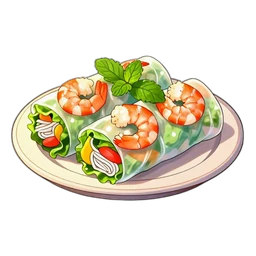
Fresh spring rolls
월남쌈
A Vietnamese dish of pork, prawn, rice vermicelli and vegetables wrapped in moistened rice paper and eaten fresh rather than fried.
Before the first bite
- Spice
- Not spicy
- Texture
- Soft · Crisp
Varies by restaurantFillings range from pork and prawn to chicken or tofu, and the dipping sauce may be topped with ground peanuts or chili powder. For dietary restrictions or allergies, ask the restaurant whether the food contains your trigger ingredients.
Taste and texture
Vietnamese spring rolls are made by dipping rice paper in water, laying boiled pork, prawn, lettuce, cucumber, herbs and rice vermicelli on top, then rolling it up. They are called goi cuon in southern Vietnam and nem cuon in the north.
Dry rice paper is a thin rigid sheet that becomes flexible when hydrated. Some wrappers use rice flour alone, others include tapioca starch for strength. It continues softening after leaving the water, so it is briefly moistened and becomes pliable while fillings are arranged. Thin areas show the filling, while overlapping areas feel thicker and chewier. Thickness, starch blend and hydration all affect the wrapper’s softness and elasticity.
Pork and shrimp are cooked separately before wrapping. Thin slices of boiled pork bend and lie flat; belly supplies alternating lean and fatty layers. Cooked shrimp can be peeled, tailed and halved lengthwise, with their coloured outer surface facing the wrapper so they remain visible.
Rice noodles enter as small bundles rather than a soup-sized portion. Cooked, cooled and drained fine noodles softly fill spaces among vegetables and firmer meat. Hungry Huy also uses banh hoi, thin rectangular mats of woven noodles that can be divided to fit. RecipeTin bundles loose noodles and sprouts in lettuce first, containing the strands before rice-paper wrapping. Noodles fill the centre while the leaf holds them together.
Soft lettuce with its hard core removed helps prevent sharp stems and vegetable tips from puncturing the wrapper. Folding both sides inward and rolling from the bottom encloses the filling in a cylinder. Hydrated rice paper sticks to itself, with shrimp and mint positioned on the visible face. Using two sheets makes handling easier but creates more overlapping layers at the ends, which become noticeably chewier than a delicate single wrapper.
Tofu and vegetables can replace meat and shrimp. Vietnam Tourism mentions tofu-and-mushroom goi cuon. Kikkoman’s published variation uses tofu sticks with red pepper, cucumber, red cabbage and courgette, plus cooked peas, rice noodles and chopped peanuts. Its separate sauce mixes soy, sesame oil, maple syrup, lime and peanut butter. This is a specific vegetable-and-tofu variation.
The rice paper stays moist and soft while the lettuce and cucumber inside stay crisp, and because the rolls are never fried they are served cool or at room temperature.
One dipping sauce combines peanut butter, hoisin and water, sometimes with garlic sautéed in oil. Hoisin supplies sweet-savoury depth and peanuts richness. Heating then cooling slightly thickens it so it clings to the roll. RecipeTin adds vinegar or lime and allows milk in place of water. Crushed peanuts on top add small nut particles within the smooth sauce, giving both a coating texture and a crumbly crunch.
A fish-sauce-based nuoc cham can flow more freely than peanut sauce. Fish sauce is diluted with water, sugar and lime or lemon juice, combining salt, sweetness and acidity. Chopped garlic and chili add visible particles, pungency and heat. The balance varies with the saltiness and aroma of the fish sauce. This thinner sauce moistens the surface and seeps between noodles, while thick peanut sauce forms a heavier coating on the mildly seasoned filling.
Herbs can remain as leaves or stems within the filling. Mint releases a cooling aroma when chewed; slender chives add an onion note and can extend beyond the end of the roll. Cilantro in the tofu variation contributes a different herbal scent. Lettuce folds softly, cucumber and pepper crunch, and noodles separate smoothly between them. The placement of springy shrimp or soft tofu changes the cross-section, preserving the distinct structures of cooked ingredients and raw leaves.
When it may suit the table
- You want something light and not oily
- You feel like eating vegetables and herbs raw
When another path may fit better
- You need something served hot
- You want to fill up on rice or noodles
How to order it in Korea
- Look for “wolnamssam” or “goi cuon” on the menu and check that it is not the fried spring roll.
- Ask whether the rolls contain prawn and whether the sauce is finished with ground peanuts.
At the restaurant
- “Wolnamssam shabu” combines shabu-shabu with rice paper for wrapping the cooked meat and vegetables.
- When wrapping your own rolls, use only as much filling as the rice paper can hold.
Show the Korean nameName and a short phrase
Use this to point out the food or say its name. Check the food-specific ordering tips above first.
월남쌈
Save, share or print an image
More guides in this category
Checked sources
Reviewed 2026-08-25 · Next check 2027-03-17