hanip.me
Nasi lemak
나시르막
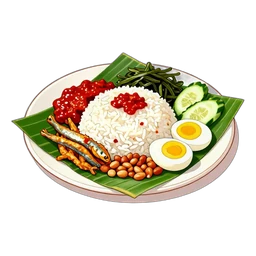
A Malaysian dish of rice cooked in coconut milk, served with spicy sambal, fried anchovies, peanuts, cucumber and boiled egg.
Before the first bite
- Spice
- Medium
- Texture
- Soft · Mixed textures
- Serving
- Usually individual
Varies by restaurantSide dishes vary by shop and may include fried chicken or rendang, while peanuts and egg are part of the standard set. For dietary restrictions or allergies, ask the restaurant whether the food contains your trigger ingredients.
Taste and texture
Nasi lemak brings coconut-and-pandan rice together with sambal and several accompaniments. Soft rice, spicy sauce, crisp anchovies and peanuts, cucumber, and egg each play a separate role. Singapore's National Heritage Board places its roots in Malay food culture. Rather than stir-frying everything into rice, the components are prepared separately and arranged around it.
Coconut milk is used while cooking the rice. National Heritage Board describes washing away excess starch and cooking with water, coconut milk, pandan leaves, and ginger. Rasa Malaysia likewise cooks the rice in water and coconut milk and removes the pandan afterward. The grains themselves carry richness and leaf fragrance rather than simply receiving a coconut sauce after cooking.
Pandan is a long leaf used to perfume the rice. Rasa Malaysia ties the leaves before adding them, while Marion's Kitchen explicitly offers lemongrass or ginger as personal substitutes when pandan is unavailable. Marion's example uses jasmine rice and coconut milk. Such adaptations have different aromatic directions from pandan-infused rice.
Sambal is the red seasoning beside the rice. National Heritage Board lists dried chilies, garlic, shallots, and belacan, a shrimp paste. Rasa Malaysia grinds and fries these, then reduces them with onion, tamarind water, and sugar. Chili heat, onion sweetness, tartness, and fermented-shrimp depth combine, giving even a small amount an impact alongside the rice.
Ikan bilis are small dried anchovies. Rasa Malaysia fries them crisp and offers them either separately or mixed into sambal. Marion's Kitchen also fries the anchovies first, sets them aside, and returns them with onion after cooking the sauce. Anchovies on the plate may therefore retain a dry crunch or have a moist red coating.
Accompaniments can go beyond peanuts, boiled egg, and cucumber. National Heritage Board describes versions with fried chicken, fried fish, or fried egg. Marion's Kitchen offers Malaysian fried chicken, ayam goreng, as an optional side. Banana-leaf packets or leaf-lined plates are also examples, ranging from compact rice-and-side portions to plates with a substantial meat addition.
The rice is moist and carries coconut richness. Pandan versions also have a gentle leaf fragrance. Coconut does not make it merely dessert-sweet: recipes season it with salt to accompany savory sides. A small taste of rice alone reveals that base before the more forceful sambal is added.
Sambal can be sweet and tangy as well as hot. Reduced chili paste clings to the grains, and tamarind-and-sugar mixtures combine acidity with sweetness. Mixing the whole rice portion makes the seasoning continuous; adding a little at a time alternates fragrant rice with the sauce. Chili heat may follow an initially sweet taste.
Fried anchovies break crisply and leave a savory fish flavor. Peanuts are rounder and firmer, adding a roasted nut aroma. Both provide crunch, but one brings seafood and the other nuts. Their different shapes and textures stand out against the soft rice.
Cucumber adds cool moisture and fresh crunch between sambal and fried components. Boiled egg has soft white and crumbly yolk, while a fried egg brings cooked edges and a different yolk texture. You can combine small amounts of rice, sambal, egg, and cucumber without finely mixing the entire plate first.
Adding fried chicken or fish makes the meat component more substantial. Portions of crust and flesh alongside rice give larger bites than anchovies and peanuts alone. Separately seasoned sides can become intense when combined with sambal. The coconut rice remains a base for the changing combinations of accompaniments.
When it may suit the table
- It suits rice and several small sides on one plate, letting you alternate sambal, anchovies, peanuts, and egg with the grains.
- Choose it to explore coconut-milk rice. Alongside any pandan fragrance, pay attention to the rice itself as well as the sides.
When another path may fit better
- If chili sauce does not appeal, ask whether sambal can be kept separate. Anchovies already mixed into sambal carry that seasoning too.
- Another dish may fit a craving for plenty of broth. Nasi lemak centers on coconut rice and accompaniments rather than rice immersed in coconut soup.
How to order it in Korea
- Look for “nasi lemak” on the menu; you'll find it where Malaysian and Singaporean food is served.
- Ask how spicy the sambal is and whether a side such as fried chicken or rendang is included.
Show the Korean nameName and a short phrase
Use this to point out the food or say its name. Check the food-specific ordering tips above first.
나시르막
Save, share or print an image
More guides in this category
Checked sources
Reviewed 2026-08-25 · Next check 2027-04-28