hanip.me
Roast chicken
로스트치킨
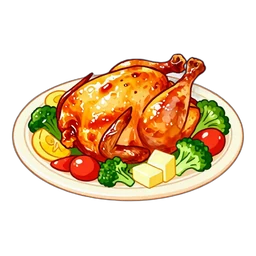
A whole chicken, seasoned and cooked in an oven, served as a Western main dish.
Before the first bite
- Spice
- Not spicy
- Texture
- Tender · Crisp
- Bones
- Usually bone-in
- Serving
- Usually shared
Varies by restaurantWhether the bird is stuffed, and what goes into the stuffing, varies from kitchen to kitchen. For dietary restrictions or allergies, ask the restaurant whether the food contains your trigger ingredients.
Hanip treats roast chicken as a challenge food. Reading this guide does not make it appear in ordinary recommendations.
Taste and texture
Roast chicken is seasoned chicken cooked by oven or fire heat. It may remain whole, be flattened, or be divided into portions. The chicken's own skin browns around fibrous meat. Unlike a flour- or breadcrumb-coated fried piece, the skin itself forms the exterior, so including it strongly affects the roasted flavour of a bite.
A whole bird cooks with breast, legs and wings attached, despite their different thicknesses and positions. Spatchcocking removes the backbone and flattens the bird to reduce uneven cooking. Serious Eats illustrates spreading the legs and roasting skin-side up. This is distinct from removing every bone.
Lemon, garlic or thyme can scent the cavity. Good Food's basic recipe uses lemon and thyme inside and butter over the breast and legs. Aromatics flavour the meat and pan juices while butter cooks with the skin. The result is a roasted combination rather than simply chicken dressed in cold lemon juice.
Stuffing is an edible mixture placed inside poultry or baked separately as an accompaniment. Bread, onion and herbs are one base; oyster, chestnut and potato versions also exist. Good Food links its roast chicken to a lemon-and-herb stuffing made with bread, onion, herbs and lemon zest and juice. That linked recipe specifically describes turkey stuffing and a separate baking dish, rather than a mandatory filling for chicken.
Pan juices can become a sauce. Good Food roasts the bird over onion and carrot, cooks flour in the tin afterward, then adds chicken stock to make gravy. The browned deposits are loosened into the liquid. Straining removes the vegetable pieces, creating a smooth accompaniment rather than a vegetable puree.
Roasted skin may be lightly crisp or chewy, with moist fibrous meat underneath. Areas shielded by the pan or another part of the bird can be less crisp than exposed surfaces. Perdue distinguishes methods aimed at darker, crisper skin from flattened-bird roasting. Eating a little meat with the thin skin joins exterior and interior textures.
The arrangement of bones and meat matters when sharing a whole bird. Broad breast pieces can be sliced, while meat is separated along the leg and wing bones. Small wings readily give skin-covered bites; breast pieces make the meat's fibres more apparent. A whole-bird plate includes choosing and separating these parts.
Resting after roasting is intended to retain juices before carving; both Perdue and Good Food include this step. At the table, try dividing portions as you eat rather than immediately shredding all the meat. A piece separated along its fibres can be combined with a little skin or sauce for moisture and roasted aroma.
Gravy adds a salty, moist coating to the meat. Skin covered generously with sauce may soften faster than a dry area. For crisp skin, try adding a little sauce mainly to the flesh. Plain pieces emphasise the chicken and roasted herbs, while sauced pieces bring in the concentrated flavour from the roasting pan.
Roasted vegetables and stuffing provide other textures. Root vegetables cooked beside or beneath chicken mingle with pan juices, while separately baked bread stuffing develops a roasted surface. Bread with herbs and onion provides a soft crumbly bite alongside meat fibres. The lemon-and-herb stuffing example also bakes with bacon and sausages, adding another meat flavour to the accompaniment.
When it may suit the table
- It suits sharing breast, legs and wings. A whole bird can be divided into convenient portions around the table.
- Choose it for roasted chicken with vegetables and sauce. Potatoes or stuffing add another texture when included.
When another path may fit better
- Check for boneless or carved meat if you do not want to work around bones. A spatchcocked bird is flattened, not fully deboned.
- For a smaller solo plate, ask whether it is a whole bird or a portion. The meat and accompaniments together determine the serving size.
How to order it in Korea
- Look for “roast chicken” on the menu, then check whether it arrives as a whole bird.
- Ask whether it comes with a stuffing and what that stuffing is made of.
Show the Korean nameName and a short phrase
Use this to point out the food or say its name. Check the food-specific ordering tips above first.
로스트치킨
Save, share or print an image
More guides in this category
Checked sources
Reviewed 2026-08-25 · Next check 2027-04-21