hanip.me
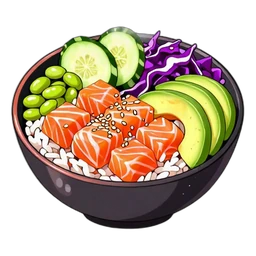
Salmon poke bowl
연어 포케
A Hawaiian dish of diced raw salmon tossed in sauce and served over cooked rice.
Before the first bite
- Spice
- Not spicy
- Texture
- Soft · Mixed textures
- Serving
- Usually individual
Varies by restaurantSoy sauce and sesame oil are the usual base, while toppings such as Maui onion, scallions, ogo seaweed, avocado and cucumber differ by shop, and some versions add chili peppers or sweet chili sauce. For dietary restrictions or allergies, ask the restaurant whether the food contains your trigger ingredients.
Taste and texture
Poke is a Hawaiian dish of diced fish tossed in sauce, and the Hawaiian word means “to cut.” Poke served over rice is called a poke bowl, and farmed salmon, along with tuna, is a widely used ingredient.
Poke and a poke bowl are distinguishable: seasoned cut fish can be eaten without rice, while placing it over rice creates a bowl meal. Colourful compartments of vegetables and fruit are a modern bowl format. Hawaii-style descriptions also include a simpler fish-and-rice arrangement, so numerous toppings are not essential. Salmon is one possible fish.
Salmon is cut into bite-sized pieces rather than laid out as thin sashimi slices. Dressing coats each piece along with small ingredients such as onion, scallions and seaweed, unlike fish served with a separate dipping sauce. It is also different from frying salmon together with rice: separately cooked rice and dressed fish retain their own forms.
Shoyu means soy sauce; one characteristic combination uses it with sesame oil, scallions and onion. That differs from Hawaiian-style sea salt, seaweed and inamona seasoning. Inamona is made from roasted ground kukui nuts, not sesame seeds. Salmon poke identifies the fish but does not specify which of these seasonings it uses.
Some recipes dress the salmon and vegetables separately. One uses soy sauce, rice vinegar, sesame oil and shichimi for salmon, and a ginger-sesame dressing for shredded vegetables. This preserves different seasoning in each component instead of one sauce poured over everything. Purple rice and beet slaw are one example of varying the base and vegetables around salmon poke.
Examples use short-grain white or brown rice, or substitute leafy greens. Using the same short-grain rice as sushi does not automatically mean vinegar-and-sugar seasoning was added. A bowl with raw fish over rice need not taste like sushi. A grain or leafy base changes what supports the fish and where the dressing gathers.
Raw salmon dressed with soy sauce and sesame oil is soft, while rice, vegetables and seaweed add contrasting textures.
Onion and scallions add crunch and pungency beside soft, rich salmon. Seaweed may provide fine branching bites or softer pieces, and sesame adds small nutty grains. Poke retains these individual textures rather than becoming a uniform mixture. A bowl topped with separate seaweed salad is also arranged differently from fish tossed with seaweed.
Some spicy poke uses mayonnaise mixed with chili sauce. Compared with a clear soy dressing, it coats the fish with an opaque, creamy layer and adds richness as well as heat. Small fish roe can contribute popping grains. Soy-based and mayonnaise-based spicy versions differ in their sauce structure, not merely their heat level.
Soy-based poke can also be spicy. Foodland in Hawaii describes a tuna poke seasoned with soy sauce, gochujang and Thai chilies. This is not a fixed salmon recipe; it illustrates that fish choice and sauce heat are separate variables. A menu mentioning chili or spicy seasoning can still be hot even when shoyu appears in its name.
Avocado adds a different smooth softness, while cucumber and radish provide a clean crunch. Vinegar dressing or pickled ginger adds acidity among those soft elements. Separately dressed shredded vegetables carry flavour on their own; with undressed vegetables, the fish's sauce plays a larger role. The extent of dressing changes each bite even with the same amount of salmon.
When it may suit the table
- You feel like raw fish served over rice
- You want a single bowl that includes vegetables and seaweed
When another path may fit better
- You need to avoid raw fish
- You'd rather have something hot than a cold bowl
How to order it in Korea
- Look for “salmon poke” or “poke bowl” on the menu; poke is usually served over rice.
- Ask which toppings you can pick beyond the soy sauce and sesame oil base, such as avocado, cucumber or seaweed.
Show the Korean nameName and a short phrase
Use this to point out the food or say its name. Check the food-specific ordering tips above first.
연어 포케
Save, share or print an image
More guides in this category
Checked sources
Reviewed 2026-08-25 · Next check 2027-02-24
- Wikipedia Opens in a new tab.
- Food Safety Korea Opens in a new tab.
- Namu.wiki Opens in a new tab.
- Encyclopaedia Britannica Opens in a new tab.
- Kathy YL Chan / Onolicious Hawaii Opens in a new tab.
- Namiko Hirasawa Chen / Just One Cookbook Opens in a new tab.
- Chatelaine Opens in a new tab.
- Foodland Opens in a new tab.