hanip.me
Greek salad
그릭샐러드
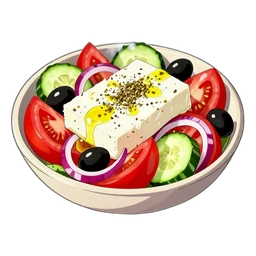
A Greek salad of tomatoes, cucumbers, onion, feta cheese and olives dressed with olive oil and oregano.
Before the first bite
- Spice
- Not spicy
- Texture
- Crisp · Soft
- Serving
- Individual or shared
Varies by restaurantOutside Greece, a salad containing lettuce may be served as “Greek salad”, though the original recipe does not contain lettuce. On the Cyclades islands, green bell pepper or caper berries may also be added. For dietary restrictions or allergies, ask the restaurant whether the food contains your trigger ingredients.
Taste and texture
Greek salad combines raw vegetables such as tomato, cucumber and onion with feta, olives, olive oil and herbs. The pieces keep their shapes instead of being finely chopped into one mixture. Juicy tomato, firm cucumber and crumbly white cheese remain distinct, inviting combinations of flavours rather than hiding everything under one dressing.
Horiatiki means village salad. A version centred on tomato, cucumber, onion, feta and olives may include green pepper, without a lettuce base. Outside Greece, the name can also describe salads containing lettuce and other additions. A leafy version is therefore a variation rather than necessarily a mistaken name.
Feta provides saltiness and acidity, not just decoration. The European Commission's PDO account describes cheese made from ewe's milk or a mixture of ewe's and goat's milk: the curd drains in moulds, is salted and matures in brine. Served over raw vegetables, it remains in white, breakable pieces rather than melting as heated cheese would.
Olive oil coats the vegetables and contributes aroma. Recipes may add a little vinegar and dried oregano, unlike a thick opaque mayonnaise dressing. Tomato juices mingle with oil and vinegar, collecting flavour at the bottom of the dish as well as on the vegetables.
Cutting also matters. My Greek Dish's example uses substantial tomato pieces, thick cucumber and thin onion for different degrees of bite. Large feta pieces can be broken off as you eat; crumbled feta spreads over more vegetable surfaces. Identical ingredients can consequently deliver cheese differently in each mouthful.
Tomato skin gives way to soft flesh and juice, while cucumber offers a firmer crunch. Green pepper adds a fresh vegetal aroma and another crisp texture. A tomato-only mouthful releases moisture differently from one containing cucumber and pepper. The dish retains raw structure rather than the sweet softness of cooked vegetables.
Raw onion adds aroma and pungency. The Mediterranean Dish's example briefly soaks thinly sliced onion in cold water to mellow it, but this is not a universal step. If raw onion troubles your palate, asking to omit it is useful; its pungency differs from green pepper's grassy flavour.
Feta's saltiness spreads through a mouthful when eaten with vegetables. A large piece alone tastes more concentrated than one with juicy tomato or cucumber. Olives also bring briny flavour, so a bite rich in both olives and cheese can taste stronger. Try vegetables and cheese together before adding salt.
Oregano contributes noticeable aroma even as small flecks, and olive oil gives a smooth coating. Vinegar, when used, adds acidity alongside tomato. The name does not establish a fixed lemon flavour or sweetness: the produce, oil, vinegar and cheese determine whether the result tastes gentle or sharply salty and tangy.
This differs from a thick Greek-yogurt-dressed salad. The white component is principally feta, not yogurt surrounding the vegetables. Even among tomato-and-cheese salads, cucumber, onion and olives change both bite and salinity. Distinguishing cheese pieces from a white sauce helps identify the composition.
When it may suit the table
- It works beside a hot meat dish when you want raw crunch and freshness. Juicy tomato and cucumber with concentrated feta provide a different experience from leaves alone.
- Choose it for substantial raw vegetable pieces. Their flavours remain distinct, making it easy to combine favourite cucumber or tomato pieces with some cheese.
When another path may fit better
- A salad alone differs from a meal centred on hot rice or noodles. Bread or another main can accompany it, but check whether those are actually included.
- Choose another vegetable dish if you want cooked softness or dislike raw onion and pepper aromas. Adding feta does not turn this into a cooked vegetable preparation.
How to order it in Korea
- Ask which vegetables and dressing are used; additions vary by restaurant.
- Feta cheese and olives are standard, so mention it in advance if you avoid dairy or olives.
Show the Korean nameName and a short phrase
Use this to point out the food or say its name. Check the food-specific ordering tips above first.
그릭샐러드
Save, share or print an image
More guides in this category
Checked sources
Reviewed 2026-08-25 · Next check 2027-04-14
- Wikipedia Opens in a new tab.
- Food Safety Korea Opens in a new tab.
- The American Heritage Dictionary of the English Language, 5th ed. (HarperCollins Publishers) Opens in a new tab.
- Namu.wiki Opens in a new tab.
- The Mediterranean Dish / Suzy Karadsheh Opens in a new tab.
- My Greek Dish / Eli K. Giannopoulos Opens in a new tab.
- European Commission Opens in a new tab.