hanip.me
Hitsumabushi
히츠마부시
Nagoya-style grilled eel over rice, enjoyed in several ways.
Before the first bite
- Spice
- Not spicy
- Texture
- Tender · Soft
- Serving
- Usually individual
Varies by restaurantWasabi adds pungent heat. Garnishes and broth vary by restaurant.
Taste and texture
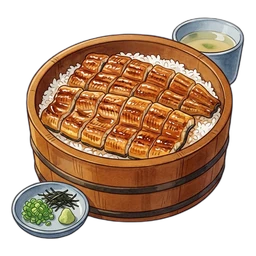
Hitsumabushi is a Nagoya dish of chopped grilled eel over warm rice, portioned into a smaller bowl and varied with condiments and broth. Like other eel bowls, it places eel over rice, but the serving lets you compare the plain dish, added garnishes and a brothy version. The rice container, empty bowl, condiment plate and broth all help explain the meal.
The name and small eel pieces reflect eating eel together with rice. In its own history, Atsuta Houraiken recounts serving both in a large wooden container, then cutting the eel smaller and mixing it with rice because diners otherwise ate the eel first and left rice behind. This is the restaurant’s account. It illustrates why eel is distributed across many mouthfuls rather than eaten as a few large pieces.
The eel’s exterior and interior matter. Specialist Bincho describes grilling without preliminary steaming to create crisp skin and tender flesh, with soy sauce, mirin and grilled aromas carrying into the rice. This is Bincho’s stated method, rather than a universal preparation for eel. The degree of surface grilling matters alongside tenderness.
Rice and sauce are separate components supporting the eel. Marusim in Korea says it developed its sauce for Korean preferences and pressure-cooks rice to complement it. Eel alone foregrounds grilled aroma and fatty richness; rice spreads the seasoning through each bite. Rice texture and the amount of sauce also shape the dish.
The liquids on the tray may have different uses. Bincho’s serving guide distinguishes a soup bowl for drinking from a pot of broth for pouring over rice. A spatula transfers portions to the empty bowl, allowing additions to that portion while the remaining rice stays unchanged. Identify the broth intended for rice when the arrangement is unfamiliar.
Compare other ways of serving eel and rice. Houraiken’s grilled-eel set serves them separately, while its donburi places relatively large eel pieces on rice. Hitsumabushi focuses on smaller pieces and several ways of eating. Choose according to whether you want individual pieces of eel or rice varied with garnishes and broth.
The first portion focuses on seasoned eel and rice as served. Nagoya Meshi describes rich tamari sauce over grilled eel and warm rice. Notice the grilled aroma, rich flesh and sweet-savoury seasoning before adding condiments. Think of leaving broth aside initially as a way to keep several combinations available, rather than a rigid rule.
Garnishes do not all contribute the same aroma. Marusim names perilla leaf, scallion and wasabi; Bincho presents scallion, wasabi and shredded nori. Leafy aromas, seaweed fragrance and wasabi’s sharpness each affect the eel differently. Add a little to a small portion to compare. Scallion or nori also offers a change if you prefer to avoid wasabi.
With broth, moist, loosening rice becomes more prominent. Nagoya Meshi describes chazuke with tea or broth and suggests finishing the last portion in your favourite of the earlier styles. Liquid connects the eel, seasoning and garnishes, changing the impression from the drier first portion. Add broth only to a small serving if you want to preserve grilled texture elsewhere.
Variations also change the seasoning. Asakusa Unatetsu describes its simmered soy-and-mirin sauce but separately presents shio, or salt-seasoned, hitsumabushi. Sweet soy glaze is therefore not the only form. Check whether a menu uses glaze or salt, and consider whether you want a familiar sauce or a stronger focus on the grilled eel itself.
When it may suit the table
- It suits a wish to vary an eel-rice meal as you go: plain eel and rice, aromatic garnishes, then a moist serving with broth. Finish by returning to the combination you liked most.
When another path may fit better
- For thick pork and a crumb crust rather than fish aroma and tender eel, consider tonkatsu. If you do want eel but prefer the grilled fish itself over changing garnishes and broth, compare a grilled-eel set with rice served separately.
How to order it in Korea
- Korean menus may also spell the name as “hijjeumabusi”. Marusim lists mini, regular and larger eel portions as well as sets with additional dishes. Look beyond size labels to the eel, rice and sides such as steamed egg or salad. Check the description for garnishes and broth intended for the rice.
Show the Korean nameName and a short phrase
Use this to point out the food or say its name. Check the food-specific ordering tips above first.
히츠마부시
Save, share or print an image
More guides in this category
Checked sources
Reviewed 2026-09-06 · Next check 2027-03-06