hanip.me
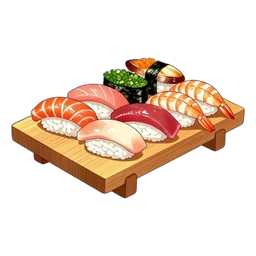
Assorted sushi
초밥 모둠
A platter that gathers several kinds of nigiri — hand-pressed vinegared rice with a slice of fish draped over each mound.
Before the first bite
- Spice
- Mild
- Texture
- Soft · Tender
Varies by restaurantThe fish on the platter varies by shop, usually seafood such as salmon and tuna, sometimes with pieces bound by a nori strip like octopus, eel or squid. For dietary restrictions or allergies, ask the restaurant whether the food contains your trigger ingredients.
Taste and texture
Assorted sushi brings together several kinds of sushi on vinegar-seasoned rice. It usually centers on nigiri, hand-pressed rice topped with fish or another ingredient, so rice and topping are eaten together rather than fish alone as sashimi. Cooked eel or egg may also appear; the word assortment does not tell you every topping.
Sushi rice uses short, rounded grains seasoned with vinegar, sugar and salt; some recipes cook it with kombu. Cooking water is adjusted for the liquid added later. Seasoning is folded into hot rice with cutting paddle movements and fanning, distributing it without crushing the grains. This rice supports the topping and supplies the underlying sweet acidity.
Nigiri pairs fish or another topping with a small oval or rounded rectangle of rice. Vinegar water on the hands reduces sticking. Wasabi may be spread beneath the fish, hidden from view. Gentle pressure holds the shape without packing a hard lump: the topping stays attached, while the rice loosens in the mouth.
Cooked prawn nigiri can use a prawn skewered straight for boiling, then peeled and butterflied from the belly. Opening it creates a broad, thin topping that drapes over rice rather than remaining curled. Its springy flesh differs from fish, and the opened centre feels thinner than the plumper edges. Preparation as well as the ingredient name describes the piece.
Gunkan wraps rice in a nori band to contain loose toppings such as flying-fish or salmon roe. Nori extending above the rice forms a small container. One variation fills it with chopped cooked prawn, cucumber and herb cream cheese, combining pieces, moisture and creaminess inside the supporting wrapper. This differs structurally from a single fish slice over nigiri rice.
Sweet-tangy rice and its topping combine in one bite. Different fish bring milder or richer flavors and varied textures.
The direction and thickness of a fish cut affect its texture. An angled, long drawing cut across salmon’s grain produces a broad slice without repeatedly tearing it. Thin edges drape over rice; the thicker centre gives a fuller soft bite. Slice thickness relative to rice changes their balance, making shape and thickness meaningful differences within an assortment.
Aburi salmon may be torched at the surface while remaining raw inside. Browned spots and warmed surface fat add grilled aroma. Surface searing therefore differs from fully cooked fish. A sweet-savoury soy, mirin and sugar sauce or thin onion can accompany it, layering sauce, seared exterior and less-cooked centre within one piece.
Egg and eel illustrate different cooked toppings. A sushi omelette may season eggs with sugar and soy, giving soft layers and sweetness beside the rice’s acidity. Grilled eel with sweet-savoury sauce supplies cooked, yielding fish flakes and a coated exterior. These add cooked textures among raw fish when included; the topping list establishes the actual assortment.
Other forms include sliced nori rolls, cone-shaped hand rolls and chirashi with toppings scattered over rice. Oshizushi is mould-pressed, while inari encloses rice in fried-tofu pockets. If rolls or inari join an assortment, their nori covering or soft tofu wrapper adds texture. The outer structure changes which ingredient reaches the mouth first, even with the same seasoned rice.
When it may suit the table
- You want to taste several things in small pieces
- You need something clean that isn't fried or stir-fried
When another path may fit better
- You need a hot broth
- You'd rather avoid raw fish
How to order it in Korea
- Look for an assorted sushi set on the menu, sometimes labeled chobap and sometimes sushi — both terms are used interchangeably for the same dish.
- Nigiri may have wasabi between the rice and topping. Removing the paste at the side of the plate may therefore leave some inside; if you want to avoid its sharp heat, ask when ordering whether it can be omitted or served separately.
Show the Korean nameName and a short phrase
Use this to point out the food or say its name. Check the food-specific ordering tips above first.
초밥 모둠
Save, share or print an image
More guides in this category
Checked sources
Reviewed 2026-09-13 · Next check 2027-03-10
- Wikipedia Opens in a new tab.
- Namu.wiki Opens in a new tab.
- Food Safety Korea Opens in a new tab.
- Encyclopaedia Britannica Opens in a new tab.
- www.justonecookbook.com Opens in a new tab.
- Kikkoman Australia Opens in a new tab.
- Yumiko / RecipeTin Japan Opens in a new tab.
- Japan Travel Opens in a new tab.
- Kikkoman Europe Opens in a new tab.
- Kikkoman Food Forum Opens in a new tab.