hanip.me
Udon
우동
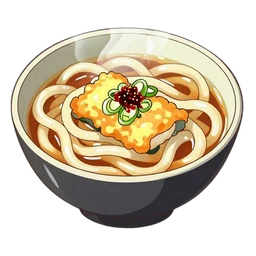
A Japanese noodle dish of thick wheat-flour noodles served in a mild broth of dashi, soy sauce and mirin.
Before the first bite
- Spice
- Not spicy
- Texture
- Brothy · Chewy
- Serving
- Usually individual
Varies by restaurantToppings such as prawn tempura, abura-age and kamaboko differ by shop, and udon may be served chilled in summer and hot in winter. For dietary restrictions or allergies, ask the restaurant whether the food contains your trigger ingredients.
Taste and texture
Udon is a Japanese noodle dish made with thick wheat noodles. Basic kake udon serves the noodles in dashi seasoned with soy sauce and mirin, often topped with scallions. The substantial noodles are central to the dish, giving a different bite from thin noodles even in a similar broth.
Handmade udon begins with flour, water and salt. Salt water is distributed through the flour to form a firm dough, which is rested, pressed and folded. Some methods press it with feet through a protective bag. Salt and repeated pressing influence elasticity; resting makes rolling easier. The eventual bounce therefore comes from mixing and working the dough as well as cutting it thickly.
Rested dough is rolled, folded and cut to even widths. Starch dusting prevents sticking, and strands are loosened before boiling. Rinsing cooked noodles removes surface starch; they can then be rewarmed for hot soup. Cooking separately prevents released starch from clouding the serving broth, distinguishing noodle-cooking water from the prepared dashi soup.
Kake broth seasons dashi with soy and mirin, sometimes sugar. Kombu and bonito or dried shiitake and kombu provide different stock bases; sliced scallion adds fresh aroma. Concentrated bottled mentsuyu can also be diluted for soup. A dipping sauce and a full bowl of broth need different concentrations, so the product’s soup dilution matters. Clear appearance still allows differences in stock and seasoning.
Kagawa’s Sanuki udon is described through elastic noodles and dashi made with small dried fish called iriko. Alongside kake with light broth and scallion, kijoyu adds only a little soy sauce and condiments. This coats the noodles more directly instead of surrounding them with abundant soup. Serving styles within the region therefore vary in liquid volume and seasoning concentration.
Thick noodles have a soft, chewy bite. The broth and toppings determine how mild or savory the dish tastes.
Mie’s Ise udon uses very thick noodles boiled soft, emphasizing yielding texture rather than strong bounce. A dark tamari-seasoned sauce may draw on bonito, kombu and other dried fish. A described style coats noodles in a small pool of sauce and adds chopped scallion. Thickness and firmness are separate traits: thick Ise noodles can be softer than springy Sanuki udon.
Goto’s hand-stretched udon uses flour, water, salt and camellia oil. Resting, oiling and stretching produce finer strands than thick cut udon. An accompanying tsuyu uses grilled, dried flying fish called ago. This introduces both a stretching process and a stock fish different from iriko, showing regional differences in dough oil and broth ingredients as well as noodle width.
Kitsune topping is fried tofu simmered sweet and savoury. One method blanches away surface oil, gently squeezes it and seasons it in dashi, sugar, mirin and soy. The pouch retains liquid, giving a soft skin and sweet moisture when bitten. It joins noodles, fish cake and scallion as a broad, separately seasoned tofu piece prepared by frying and then simmering.
Yaki udon cooks noodles with pork, cabbage, carrot and onion in a pan. One method layers vegetables and noodles over pork, steam-cooks them, then loosens and turns the noodles while frying. Rendered fat spreads as moisture evaporates. Soy is added to an exposed hot area for aroma, then mixed through and finished with bonito flakes. Coated noodles meet crisp cabbage and browned meat rather than swimming in broth.
When it may suit the table
- You want a warm broth that isn't sharp or spicy
- You want a single bowl that keeps things light
When another path may fit better
- You crave a hot, spicy broth
- You'd rather fill up on rice than noodles
How to order it in Korea
- If you want hot broth, check that you are ordering a soup udon. Cold styles include zaru udon, with noodles dipped in a separate concentrated sauce, as well as versions with broth or sauce poured over them. Check the serving style in the menu photo rather than assuming that cold udon means a full bowl of soup.
- Ask whether you can pick toppings such as prawn tempura, abura-age or kamaboko, and whether shichimi is available on the side.
Show the Korean nameName and a short phrase
Use this to point out the food or say its name. Check the food-specific ordering tips above first.
우동
Save, share or print an image
More guides in this category
Checked sources
Reviewed 2026-09-13 · Next check 2027-03-10
- Wikipedia Opens in a new tab.
- Namu.wiki Opens in a new tab.
- Food Safety Korea Opens in a new tab.
- Encyclopaedia Britannica Opens in a new tab.
- Namiko Hirasawa Chen / Just One Cookbook Opens in a new tab.
- Ministry of Land, Infrastructure, Transport and Tourism, Japan Opens in a new tab.
- Ministry of Agriculture, Forestry and Fisheries, Japan Opens in a new tab.
- Japan Travel Opens in a new tab.
- Yuto Omura / Sudachi Opens in a new tab.
- Makiko Oda / Kikkoman Opens in a new tab.