hanip.me
Katsudon
카츠동
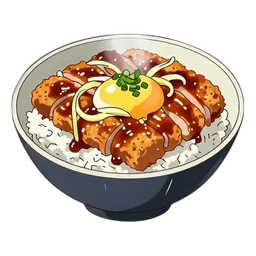
A Japanese rice bowl topped with a fried pork cutlet cooked together with egg and onion.
Before the first bite
- Spice
- Not spicy
- Texture
- Soft · Crisp
- Serving
- Usually individual
Varies by restaurantRegional variations include sosu katsudon, served with tonkatsu or Worcestershire sauce, and demi katsudon topped with demi-glace. For dietary restrictions or allergies, ask the restaurant whether the food contains your trigger ingredients.
Taste and texture
Katsudon is a Japanese rice bowl topped with a fried pork cutlet cooked with egg and onion in a soy-based broth. Its name combines tonkatsu and donburi. Unlike a cutlet set with rice on the side, the egg, onion and broth join the cutlet to the rice for spoonfuls of the whole dish.
Tonkatsu coats pork loin or tenderloin in flour, egg and breadcrumbs before frying. Scoring connective tissue between lean and fat limits curling. Tenderloin may yield smaller pieces than a loin cutlet, and thickness varies. Frying creates a coarse crisp crust around the meat’s grain; egg katsudon then combines this prepared cutlet with onion and broth.
Thin onion is softened in dashi before cutlet pieces are placed above it. Soy, mirin and sugar give a sweet-savoury base; kombu-bonito stock or a dashi packet adds fish and seaweed flavour. Precooking the onion avoids a prolonged wait with the cutlet already in the liquid. It forms a soft vegetable layer transferred to rice with the broth.
Egg is poured into gaps around the cutlet and over it. Adding part first and the rest later lets the earlier egg hold onion and meat while the upper layer finishes more softly. Lightly mixing whites and yolks leaves marbling; more uniform beating spreads an even colour. Mixing and timing shape the appearance and softness of the egg layer.
The cutlet can be sliced while retaining its original arrangement. Broth enters the gaps and egg bridges them, allowing individual pieces to be lifted. A small pan forms a rounded topping that transfers easily; a larger pan can position separate portions for dividing later. Rice is cooked separately, then receives the topping and pan liquid from above.
Sweet-salty broth flavors the rice, while egg adds softness. The coating softens in the broth compared with a cutlet served on its own.
The cutlet’s underside absorbs broth while soft egg covers the top. Sliced faces expose the pork inside its moistened breadcrumb layer. Thicker pieces emphasize the meaty centre; thinner ones allow proportionally more contact with broth. Thickness and immersion work together, contrasting yielding egg and onion with meat that retains a distinct grain.
Fukui’s sauce katsudon is described as thin pork coated in fine breadcrumbs, fried and dressed while hot. Worcestershire-style sweetness and acidity penetrate the cutlet. The sauce directly seasons its surface, unlike an egg-and-broth layer. Fukui’s tourism guide describes many versions with only rice and cutlets, without cabbage; this is a regional pattern rather than a universal rule.
Yamanashi’s version layers shredded cabbage and tonkatsu over rice, then adds sauce. Crisp vegetable strands sit between rice and crust. MAFF’s regional recipe also includes lemon and mustard, adding acidity or pungency. This creates a different structure from the egg-and-soy-broth version: raw shredded vegetables separate the rice and cutlet instead of egg binding the topping.
Chicken katsudon substitutes a breaded chicken cutlet. One recipe shallow-fries tenders and also suggests thinly butterflied breast or thigh. The fried meat still joins onion, egg and sweet-savoury dashi over rice. Tenders form narrow pieces, while butterflied breast can form a larger cutlet. Chicken grain replaces the fatty edge of pork loin, changing shape and bite beneath the egg.
When it may suit the table
- When you want a rice bowl where the sauce has soaked all the way in
- You want meat and rice together in one filling bowl
When another path may fit better
- Deep-fried food feels too heavy
- You need a dish with a hot broth
How to order it in Korea
- Look for “katsudon” on the menu and make sure not to confuse it with plain tonkatsu, where the cutlet is served on its own.
- Egg-topped katsudon differs from sauce katsudon, where the cutlet is dressed with sauce. In the egg version, broth softens the coating, so it does not have the same crunch as a cutlet served on its own. If you want egg and moist rice, check that it is the version cooked with egg.
Show the Korean nameName and a short phrase
Use this to point out the food or say its name. Check the food-specific ordering tips above first.
카츠동
Save, share or print an image
More guides in this category
Checked sources
Reviewed 2026-09-13 · Next check 2027-03-10
- Wikipedia Opens in a new tab.
- Food Safety Korea Opens in a new tab.
- Namu.wiki Opens in a new tab.
- Nippon.com Opens in a new tab.
- Yumiko / RecipeTin Japan Opens in a new tab.
- Namiko Hirasawa Chen / Just One Cookbook Opens in a new tab.
- Yuko Ihara / Kikkoman Opens in a new tab.
- Fukui City Tourism Association Opens in a new tab.
- Ministry of Agriculture, Forestry and Fisheries, Japan Opens in a new tab.