hanip.me
Mala xiang guo
마라샹궈
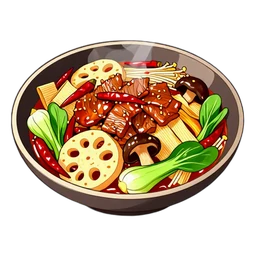
Mala xiang guo is a Chinese stir-fry of meat and vegetables in mala seasoning, served without a soup base.
Before the first bite
- Spice
- Hot
- Texture
- Mixed textures
- Serving
- Individual or shared
Varies by restaurantCustomers usually choose the meat and vegetables themselves, so the same dish can arrive with a different mix each time. For dietary restrictions or allergies, ask the restaurant whether the food contains your trigger ingredients.
Hanip treats mala xiang guo as a challenge food. Reading this guide does not make it appear in ordinary recommendations.
Taste and texture
Mala xiang guo stir-fries meat, seafood, tofu and vegetables in mala seasoning. Rather than spooning broth as in malatang, you eat pieces coated in concentrated sauce. The English name “dry pot” does not mean dehydrated food: as The Mala Market explains, enough sauce remains to moisten the ingredients, without the large broth base used for cooking hot pot at the table.
Different ingredients need different preparation. Omnivore’s Cookbook blanches firmer and tender vegetables separately, cooks meat and shrimp, then brings them together in sauce. The final seasoning is shared, but the cooking times of potatoes, greens and meat are addressed first. That sequence helps explain how crisp lotus root and soft tofu can remain distinct in one bowl.
The aromatics extend beyond chilies. A Woks of Life version infuses oil with Sichuan pepper, star anise, fennel and cinnamon, removes the whole spices, then uses that oil for the sauce and ingredients. Aroma travels through the oil coating the pieces rather than only through a dusting of spice. Visible chilies alone do not reveal the full aromatic profile.
Saltiness and fermented bean flavour also matter. Omnivore’s Cookbook combines hot-pot base with doubanjiang and black-bean sauce. Lee Kum Kee labels its hot-pot base for dry-pot use too, listing pickled chili, soy sauce, oil and fermented soybean paste among the ingredients. Mala sauces are not one fixed formula; soy and bean seasonings contribute savouriness alongside chili intensity.
Tofu products offer contrasting textures. Pressed tofu sheets can be sliced into strips; fuzhu is dried film lifted from heated soy milk and rehydrated before use. Fried tofu has an airy interior that takes up sauce. Omnivore’s Cookbook presents several tofu products as dry-pot choices. Thin layers, folds and porous centres provide more variety than a single solid block suggests.
Meat and seafood change the plate too. The Mala Market prepares pork belly, shrimp and fried tofu before combining them with vegetables: fatty pork, springy shrimp and sauce-soaked tofu sit together. Other versions use sliced beef, fish or fish balls. The dish centres on contrasts among ingredients more than on one dominant cut of meat.
Chili heat overlaps with Sichuan pepper’s tingling sensation. The Woks of Life describes the pepper’s tongue-numbing character and its whole and ground forms. In dry pot, aromatic oil and chili seasoning coat multiple ingredients. Enjoying hot chilies does not necessarily mean being familiar with this tingling, so notice the two sensations separately in your first bite.
Wood ear and leafy vegetables remain different under the same sauce. Wood ear retains a slightly crisp spring in stir-fries, while shiitake adds flesh and mushroom flavour. Bok choy combines thicker stems and thinner leaves. Omnivore’s Cookbook also uses enoki and lotus root, adding fine strands and firmer crunch. Alternate softer and crisper pieces to appreciate those differences.
Sauce settles differently on each ingredient. Folds of tofu sheet and the airy centre of fried tofu hold seasoning; smoother shrimp or lotus root carry it on the surface. The Woks of Life’s tofu guide highlights how these ingredients take up other flavours. Tofu does not automatically make a mild bite: sauce-filled areas can taste intensely of mala.
Finishing garnishes also matter. The Mala Market uses sesame seeds, while The Woks of Life adds chopped cilantro. Nutty seeds and leafy cilantro aroma differ over the rich sauce. Rice offers a plainer bite alongside seasoned ingredients; Mama99 in Korea also presents shrimp fried rice as an accompaniment, changing the overall meal’s flavour.
When it may suit the table
- A day you want the numbing heat of mala
- You want to pick the meat and vegetables yourself
When another path may fit better
- You need something without spice
- When you want a mala dish with broth.
How to order it in Korea
- Look for “mala xiang guo”. As Mama99’s Korean menu illustrates, sauce-based stir-fried xiang guo and broth-based malatang are separate dishes. Check both the name and preparation description according to whether you want soup or coated ingredients.
- If you choose the ingredients yourself, compare textures such as lotus root, mushrooms and tofu alongside meat. They will be stir-fried together, so check unwanted ingredients before selecting them. If you want rice or noodles alongside, ask whether your chosen set includes them.
Show the Korean nameName and a short phrase
Use this to point out the food or say its name. Check the food-specific ordering tips above first.
마라샹궈
Save, share or print an image
More guides in this category
Checked sources
Reviewed 2026-08-25 · Next check 2027-04-28
- Omnivore's Cookbook Opens in a new tab.
- Wikipedia Opens in a new tab.
- Food Safety Korea Opens in a new tab.
- Namu.wiki Opens in a new tab.
- Encyclopaedia Britannica Opens in a new tab.
- thewoksoflife.com Opens in a new tab.
- The Mala Market · Taylor Holliday Opens in a new tab.
- Lee Kum Kee Korea Opens in a new tab.
- Mama99 Opens in a new tab.