hanip.me
Fruit mochi
과일 찹쌀떡
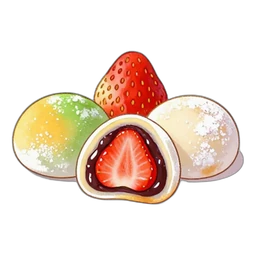
Fruit wrapped in chewy rice cake.
Before the first bite
- Spice
- Not spicy
- Texture
- Chewy · Mixed textures
Varies by restaurantFruit and fillings vary.
Taste and texture
Fruit chapssaltteok wraps fruit and filling such as sweet bean paste in glutinous rice dough. It adds fresh fruit to a basic bean-filled cake, creating distinct skin, paste and fruit layers. Strawberry versions belong here, but the category is not limited to strawberries. A cake enclosing actual fruit differs in structure from fruit-flavored dough or a snack with fruit only on top.
The skin is made by cooking glutinous rice flour with water, sugar and other ingredients into a wrapping dough. Foodnuri’s general fruit example heats and stirs it in a microwave; its grapefruit example steams, kneads and rolls it out. Both cook the rice-cake component before enclosing the fruit. This is neither raw flour hardened around fruit nor fruit-filled dough baked and risen like bread.
Fruit may be whole or cut. Just One Cookbook’s strawberry daifuku wraps a whole strawberry in bean paste and then mochi. Foodnuri’s grapefruit example cuts peeled flesh and encloses it with paste and dough. Their cross-sections differ, but both combine fruit and filling within a chewy wrapper.
This also differs from crumbly seolgi. Seolgi steams moistened, sifted non-glutinous rice flour in a mold, whereas fruit chapssaltteok flattens cooked glutinous dough around a filling. Both are rice cakes, but their ingredients and shaping methods differ. Here the skin encloses a fruit center; in basic bean chapssaltteok, bean paste mainly fills that space.
The wrapper has a stretchy chew, while the center contains moist fruit flesh. The skin-only edge, a thick patch of paste and the fruit center give different bites. When all three meet, the wrapper’s elasticity contrasts with fruit moisture and the paste connects them with sweetness. Fruit inside does not flavor every part of the cake uniformly.
Bean paste, made from softened beans mashed and sweetened, gives a thick texture unlike fruit juice. Maangchi’s basic chapssaltteok recipe also cooks beans until soft, mashes them and adds sweetness. Around fruit, the paste can lead in some bites while fruit leads in others. The ratio of dough, paste and fruit therefore changes the impression even with the same fruit.
The type of paste also changes the flavor. Strawberry-daifuku variations include red bean paste, white bean paste and cream, while a fruit specialist lists white-bean strawberry and pineapple options. White filling is not necessarily whipped cream. A bean-forward version and a cream-containing version pair differently with the same strawberry, so the fruit name alone does not describe the whole filling.
Working the cooked glutinous dough is part of developing the chewy wrapper. Surface starch helps reduce sticking to hands and the work surface, unlike decorative sugar. A powdery exterior can still cover an elastic rice-cake skin. Nor does the powder reveal the moisture in the fruit and paste. This pronounced contrast between outside and inside is characteristic of fruit chapssaltteok.
When it may suit the table
- It suits a craving for fruit moisture and rice-cake chew together, especially if you enjoy plain bean chapssaltteok and want another flavor and texture inside.
- It is worth choosing to compare fruit centers. Starting with a familiar fruit lets you notice how it changes when surrounded by dough and paste.
When another path may fit better
- Plain chapssaltteok may fit better if you want consistent bean flavor without juice or tang. Removing a substantial fruit center leaves space and changes the balance of dough and filling.
- If you enjoy fruit but not bean paste, check the filling first. A fruit name can still accompany paste or cream; do not assume it contains only fruit.
How to order it in Korea
- Ask which fruit is used, whether paste or cream accompanies it, and whether the fruit is whole or cut. A cross-section shows the proportions; check that it matches the current product.
- Some examples use a fruit with bitterness, such as grapefruit. Consider a different fruit if that is not your preference. For less sweetness, check paste and added sugar as well as the fruit.
- Similar outer sizes may hide thick dough or a larger fruit. When choosing several, check whether only color and shape differ or the fruit-and-paste combinations differ too.
At the restaurant
- Pulling the dough into a long strip can separate it from the fruit and paste. Divide the cake into manageable pieces on a plate and include all three in the first bite.
- The surface powder may be starch. Do not assume it is extra sugar; taste a little dough and filling to judge the sweetness.
- Cutting a whole-strawberry version reveals the fruit, surrounding paste and outer skin. Look just after cutting if you want a photo. A cut-fruit version need not have the same cross-section.
- For takeaway, state when you will eat and your travel time, and check the product directions. Fruit-daifuku sellers set their own use-by dates; plain bean mochi or one recipe’s conditions cannot stand in for every product.
Show the Korean nameName and a short phrase
Use this to point out the food or say its name. Check the food-specific ordering tips above first.
과일 찹쌀떡
Save, share or print an image
More guides in this category
Checked sources
Reviewed 2026-09-13 · Next check 2027-03-13