hanip.me
Gyoza
교자
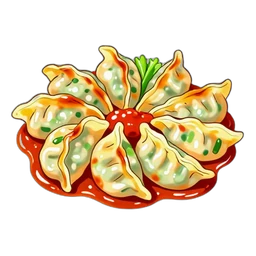
Gyoza are Japanese dumplings with minced meat and vegetables wrapped in thin dough and pan-fried on one side.
Before the first bite
- Spice
- Not spicy
- Texture
- Crisp · Soft
- Serving
- Usually shared
Varies by restaurantSome places boil or deep-fry them instead of pan-frying, and the filling may use chicken or beef instead of pork. For dietary restrictions or allergies, ask the restaurant whether the food contains your trigger ingredients.
Hanip treats gyoza as a challenge food. Reading this guide does not make it appear in ordinary recommendations.
Taste and texture
Gyoza enclose meat and vegetables in thin wheat wrappers. Related to Chinese jiaozi, the familiar yaki-gyoza style browns one side in a pan and finishes with steam. The folded dumpling sits on its base with the pleated edge upright, exposing different parts to different kinds of heat.
Ground pork may be combined with cabbage, spring onion, garlic chives, ginger and garlic. Finely chopped ingredients fill the thin wrapper evenly. Meat-heavy mixtures have more cohesion and concentrated meat flavour; vegetable-heavy versions reveal more chopped vegetables and moisture.
Vegetable preparation affects the wrapper. Just One Cookbook salts finely chopped cabbage and squeezes out moisture before adding it, reducing excess liquid that could seep into the pastry. Mixing meat and seasonings until sticky helps the cooked filling hold together softly instead of falling into loose crumbs.
Cabbage is not mandatory. Tim Anderson's recipe published by JNTO uses pork with leek, ginger and garlic. Leek is related to spring onion. Alongside a cabbage-and-shiitake mixture, this shows the range of flavours and textures that can fill the thin wrapper.
Wrappers can be bought or made from flour and water. Anderson combines flour, salt and hot water, rests the dough, then rolls small pieces into thin rounds. Filling goes in the middle; water helps seal the folded edge. Dry pastry or too much filling makes sealing difficult.
Yaki-gyoza begins with a little oil and browning on the base. Water is then added and the lid closed so steam cooks the top and filling. Finally the lid is removed and remaining water evaporates, crisping the base again. This sequence of frying and steaming creates its contrasting exterior and interior.
The base breaks crisply while the steamed top bends softly, with ground meat and vegetables in the centre. Unlike a fully deep-fried dumpling, crispness is concentrated on the pan-browned bottom.
Pleated edges contain overlapping pastry and feel thicker than the centre. Moist filling against the crisp base provides a balance distinct from an overly thick wrapper or dry filling. Start with a small bite of freshly served gyoza to enjoy the hot interior gradually.
Garlic and ginger add sharp, aromatic notes. Chives and spring onion bring their own allium fragrance, cabbage becomes soft and gently sweet, and shiitake pieces add mushroom aroma and savouriness in versions that use them.
Soy sauce and vinegar provide the salty, acidic dip, with optional la-yu chilli oil. Since the filling is already seasoned, start with a little. More vinegar increases tang, while chilli oil adds heat, aroma and oily richness.
Boiled sui-gyoza has a smooth, moist wrapper, while deep-fried age-gyoza crisps across its exterior. Cooking method changes the pastry even with the same filling. Asking whether a menu's gyoza is fried or boiled is a practical way to identify that texture.
Adaptations can use ground chicken or beef. Changing the meat affects fatty richness and cohesion, along with the vegetable proportion. More chives and garlic can intensify aroma even with the same meat. Read the meat, vegetables and aromatics together when choosing a filling.
A crisp base softens as it absorbs dipping sauce. Add a little sauce to each piece if you want to retain the browned texture. Lifting a whole piece and eating wrapper and filling together brings both textures into the same bite.
When it may suit the table
- A day you want a side dish to go with ramen or another main
- You want a crisp skin and a soft filling in the same bite
When another path may fit better
- You need something not cooked in oil
- You want a single rice bowl to finish the meal
How to order it in Korea
- Look for “gyoza” on the menu, then check whether it is pan-fried yaki-gyoza or a boiled or deep-fried version.
- Ask whether the filling is pork, chicken or beef, and whether it contains garlic.
Show the Korean nameName and a short phrase
Use this to point out the food or say its name. Check the food-specific ordering tips above first.
교자
Save, share or print an image
More guides in this category
Checked sources
Reviewed 2026-08-25 · Next check 2027-04-28