hanip.me
Macaron
마카롱
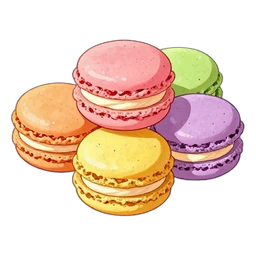
A French sandwich cookie: two round shells of meringue and almond flour joined by a cream or jam filling.
Before the first bite
- Spice
- Not spicy
- Texture
- Soft
- Serving
- Usually individual
Varies by restaurantFillings range from buttercream and ganache to jam and fruit, so flavours and colours differ by shop. Almond flour is a base ingredient, so take particular care with nut allergies and ask the shop about ingredients if you have dietary restrictions.
Taste and texture
A macaron sandwiches a filling between two shells baked from meringue, almond flour and sugar. The shells are often called coques, while cream or jam in the middle is the filling. Because they are made separately, the same almond shell can hold chocolate ganache or fruit-flavored cream. Its color alone therefore does not reliably tell you the flavor.
Meringue starts with whipped egg whites. Folding and working in the sugar and almond flour is called macaronage. The mixture must flow into rounds without losing all its bubbles. King Arthur Baking describes deliberately removing some air while retaining enough for a light structure. This differs from rolling out flour-based cookie dough and cutting shapes from it.
There are different ways to make the meringue. Sue Gray’s Italian-meringue version whips hot sugar syrup into egg whites before adding almond flour. The batter is piped into rounds, dried on the surface and baked. The baked shells have fairly smooth tops and little ruffled rims around their lower edges, sometimes called feet.
The shells can carry flavor too. Variations in the same recipe use espresso powder or cocoa; pistachio and hazelnut versions replace part of the almond flour with the other nut flour. A green macaron may therefore contain almonds alongside another nut, and some shells get their color only from coloring. Color decorates; the batter and filling ingredients determine flavor.
Ganache is made by combining chocolate and cream. Valrhona describes adding hot cream to chocolate in stages to form a smooth emulsion, then letting it set as required. A macaron needs ganache firm enough to hold between its shells, rather than a freely flowing chocolate sauce. Variations include adding butter or extra cream and whipping the mixture.
It helps to distinguish coconut macaroons, whose English name looks similar. Wilton’s coconut version combines shredded coconut with egg whites and sugar, then bakes it in mounds. It is a dense cookie with distinct coconut pieces, unlike a filling sandwiched between smooth almond shells. When macaron and macaroon look confusing on a menu, checking ingredients and the cross-section clarifies the difference.
The thin outside cracks lightly on the first bite; the inside is moist and chewy. Almond savoriness meets the sweet filling, so tasting a shell alone differs from biting through the center. Think of a small sandwich joining two textures rather than a cookie that stays crisp throughout. More filling gives the soft center a greater presence.
Buttercream can differ considerably from the whipped cream its name might suggest. David Turner’s French buttercream combines yolks with sugar syrup before incorporating butter until smooth. Its ingredients also differ from Swiss and Italian buttercreams made with whites. Rich yolk flavor and butter savoriness mean that even vanilla macarons may feel different depending on the type of filling.
A fruit flavor does not necessarily mean whole fresh fruit inside. Buttercream may contain fruit purée or concentrate, while other versions use jam or lemon curd. Fruit mixed into cream flavors its soft base throughout; jam makes the fruit center more distinct. The same fruit name may therefore describe different balances of creamy richness and tartness.
For chocolate versions, consider the shell and filling separately. Cocoa flavors the shell itself, while ganache creates a smooth, concentrated chocolate layer in the center. Paris Baguette describes its chocolate macaron as almond shells filled with chocolate ganache. Chocolate-flavored buttercream is another possibility, so the filling type tells you more than whether the shell is brown.
Freshly baked shells differ from assembled macarons that have rested. Sue Gray’s recipe explains that maturation softens the shells slightly and lets the flavors come together. The appeal is not uniform crispness but the contrast between a thin cracking exterior, chewy interior and soft filling. A heavily filled macaron also puts more cream into each bite.
When it may suit the table
- When you want just a small sweet thing with coffee
- When you want something colourful to give or share
When another path may fit better
- When you have a nut allergy — almond flour is a base ingredient
- When you need a snack that actually fills you up
How to order it in Korea
- At a Korean bakery, look beyond the flavor name to whether the filling is ganache, buttercream or jam. Chocolate ganache, for example, is a useful clue when you want a concentrated chocolate layer. For a mixed selection, varying actual ingredients such as chocolate, nuts and fruit may reveal more differences than choosing different colors. If you have allergies, check filling ingredients as well as the almonds in the shells with the shop.
Show the Korean nameName and a short phrase
Use this to point out the food or say its name. Check the food-specific ordering tips above first.
마카롱