hanip.me
Ratatouille
라따뚜이
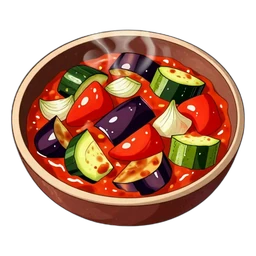
A dish from southern France that cooks summer vegetables such as aubergine, courgette, bell pepper and tomato together in olive oil.
Before the first bite
- Spice
- Not spicy
- Texture
- Soft · Tender
Varies by restaurantVariations exist, such as confit byaldi, which arranges thin vegetable slices in layers instead of stewing them, and the herbs used range from basil to marjoram and thyme depending on the kitchen. For dietary restrictions or allergies, ask the restaurant whether the food contains your trigger ingredients.
Hanip treats ratatouille as a challenge food. Reading this guide does not make it appear in ordinary recommendations.
Taste and texture
Ratatouille is a southern French vegetable dish of ingredients such as eggplant, zucchini, tomato and bell pepper cooked with olive oil, aromatics and herbs. Onion and garlic form an aromatic base, while tomato moisture connects the vegetables. In the chunky form, the pieces mingle but retain their shapes. The flavour develops from cooking vegetables rather than requiring meat.
Preparation affects the finished bite. Good Food cuts eggplant into chunks, zucchini into substantial pieces and deseeded peppers into strips, and removes tomato skins and seeds. This is one way to manage tougher skins and moisture among the tender vegetables. Because the ingredients are not pureed, their cut sizes remain part of the eating texture.
One method cooks the vegetables separately before combining them. GialloZafferano cooks and sets aside eggplant and zucchini, then cooks onion and garlic with peppers and tomatoes before bringing everything together. Their different cooking rates mean a long shared simmer can break down the first vegetables to soften. Separate cooking allows each component to be managed before the flavours combine.
Herbs can enter at different stages. GialloZafferano uses thyme during cooking and parsley and basil at the end; Good Food also finishes with basil. Their aroma rises above the cooked tomato and vegetables. The chosen herbs are part of the recipe's flavour rather than a compulsory set that must always be used together.
The related confit byaldi variation arranges thin round vegetable slices in overlapping layers. A ratatouille order can instead arrive as a mixture of chunky vegetables. These methods create different presentations. Cooked vegetables with tomato, olive oil and herbs are more useful identifiers than an elaborate striped arrangement alone.
Eggplant softens and carries the flavour of oil and tomato; its flesh yields gently inside the skin. Zucchini offers moist tenderness, while pepper flesh and skin can retain a clearer resistance. Although all the vegetables are cooked, each spoonful can contain a different kind of softness.
Cooking mellows the sharpness of onion and contributes sweetness. Garlic and olive oil add aroma, while tomato adds acidity and moisture. Think of cooked vegetable sweetness balanced with tomato rather than a necessarily sugary sauce. Good Food's recipe illustrates adjusting that balance with a little sugar and vinegar.
Separately cooked vegetables can have pan-cooked surfaces and moist interiors. Combining them lets their juices mingle into a sauce around the pieces. It is closer to substantial vegetables with accompanying juices than a bowl dominated by broth. Bread can help carry the tomato and olive oil left on the plate.
Basil or parsley added at the end brings leafy aroma among the cooked vegetables, while thyme cooked into the dish flavours the tomato base. Try a little herb with the vegetables instead of removing every leaf. A large piece of basil can make one bite particularly aromatic, so starting with less can help if the herb is unfamiliar.
Ratatouille can accompany rice, potatoes or bread, or sit beside meat or fish, as GialloZafferano illustrates. Bread carries the moist vegetables; rice or potatoes take up their sauce. It suits a meal focused on tender cooked eggplant and zucchini rather than the crunch of a raw salad.
When it may suit the table
- It suits a craving for tender cooked eggplant and zucchini, with vegetable pieces brought together by tomato.
- Choose it for tomato, olive oil and herb flavours. Bread, if served, can carry the remaining vegetable juices.
When another path may fit better
- If you want a plate including rice or meat, check its accompaniments. Ratatouille itself centres on cooked vegetables.
- Another vegetable dish may suit a dislike of soft eggplant or pepper aroma. Their flavours mingle during cooking and may remain after a piece is removed.
How to order it in Korea
- Look for Ratatouille and ask whether it is a separate vegetable dish or accompanies another item.
- Some kitchens stew the vegetables while others layer thin slices, so ask which style they serve.
Show the Korean nameName and a short phrase
Use this to point out the food or say its name. Check the food-specific ordering tips above first.
라따뚜이
Save, share or print an image
More guides in this category
Checked sources
Reviewed 2026-08-25 · Next check 2027-04-21