hanip.me
Cha siu bao
차슈바오
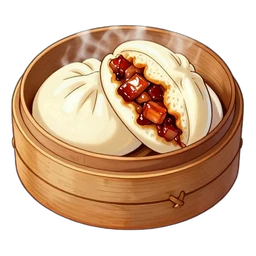
Char siu bao is a steamed Cantonese bun filled with sweet-savory barbecued char siu pork.
Before the first bite
- Spice
- Not spicy
- Texture
- Soft · Tender
- Serving
- Usually shared
Varies by restaurantThere are two kinds, a steamed one with a white exterior and a baked one glazed brown with an egg wash, and the baked version is slightly sweeter and more bready. For dietary restrictions or allergies, ask the restaurant whether the food contains your trigger ingredients.
Hanip treats char siu bao as a challenge food. Reading this guide does not make it appear in ordinary recommendations.
Taste and texture
Char siu bao is a Cantonese bun wrapped around sweet-savory barbecued pork. White steamed versions appear as dim sum, while browned baked versions are also found in Chinese bakeries. Both use cooked pork cut up and mixed with sauce. Although the bun may resemble a sweet snack, its filling is meat rather than cream or bean paste, making it a choice for a meal or a snack.
Char siu names the roasted pork, not the bread. Daddy Lau seasons pork shoulder with soy, oyster and hoisin sauces, fermented bean curd and five-spice, then roasts it with a honey glaze. This layers sweetness, saltiness and spice aroma. Cutting that pork into a bun filling retains a roasted flavor different from a dumpling filled with raw mince.
A thick sauce holds the pork pieces together. Judy Leung cooks onion with soy and oyster sauces, thickens chicken stock with flour, then mixes in the char siu. The filling is more cohesive and moist than plain diced meat. Its savory flavor and sheen come from this sauce as well as the pork’s own seasoning.
The white bun’s fluffiness comes from its dough and rising process. Judy Leung combines wheat flour and cornstarch, rests a yeast dough, then adds baking powder. Some buns are deliberately made to open on top during steaming. A split revealing the filling can therefore be part of the shape rather than an accidentally burst dumpling.
Baked versions can use a different dough. Sarah Leung encloses the filling in milk bread made with cream and egg, brushes it with egg wash before baking, and finishes it with sugar syrup. That example combines a glossy brown surface, soft crumb and rich pork filling; it does not define the formula or coating of every baked bao.
The sauce can be thickened in different ways. Wei Guo thickens an onion-infused sauce with starch, cools it, then mixes in chopped char siu. This makes the filling manageable to wrap before it softens again during steaming. Expect sauce clinging to pork and bread rather than the clear liquid released by a soup dumpling.
A steamed bao tears into light, fluffy bread around moist pork pieces. Wei Guo explains that the flour can produce a very light crumb or a slightly chewier one. The appeal is bread softening around the filling rather than a long-chewing dumpling skin. Eating bread and filling together also distributes the sweet-savory seasoning.
Red or dark-brown filling does not by itself indicate chili heat. Daddy Lau’s char siu combines sugar and honey, fermented seasonings and five-spice aroma; some preparations also use coloring. Whether you enjoy sweet roasted pork and aromatic spices is a more useful guide to the flavor than the color alone.
In a baked version, compare the surface with the interior. An egg-washed, syrup-finished example gives a sweet outer layer followed by soft bread and pork. It is not a hard-crusted loaf throughout. Look for the steamed form when you want fluffy steamed bread, or a baked form when the browned surface also appeals.
Tea is another accompaniment. Christine Gallary suggests jasmine or chrysanthemum tea alongside the buns, offering a different aroma between bites of sweet-savory pork bread. Split a freshly steamed bun and check the filling’s heat before taking a large bite: even without free-flowing broth, the meat and sauce can be hot.
When it may suit the table
- A day you want fluffy dough with a tender meat filling
- You want dim sum to share with others
When another path may fit better
- A sweet-savory sauce feels like too much
- You're after a numbing, spicy flavor
How to order it in Korea
- On Korean menus, read the cooking method and topping alongside “chasyu bao.” L’Escape’s Palais de Chine menu lists a baked char siu bao with butter crumble. Such a topping gives a different choice from a white steamed bao. Checking whether it is steamed, baked or finished with a crisp topping helps match the texture you want. That menu lists char siu bao separately from soup dumplings, har gow and siu mai, and lists roasted char siu pork as another dish. Ordering only “char siu” may therefore mean pork without bread. When sharing dim sum, check the unit of buns and the other dumplings, and distinguish whether you want bread, dumplings or roast meat.
- When choosing by sweetness, ask about the filling sauce and surface coating as well as whether the bun is steamed or baked. A steamed bao can still have sweet pork seasoning and sugar in the dough; steaming does not make it unsweetened.
Show the Korean nameName and a short phrase
Use this to point out the food or say its name. Check the food-specific ordering tips above first.
차슈바오
Save, share or print an image
More guides in this category
Checked sources
Reviewed 2026-08-25 · Next check 2027-05-05
- Wikipedia Opens in a new tab.
- Food Safety Korea Opens in a new tab.
- Encyclopaedia Britannica Opens in a new tab.
- Namu.wiki Opens in a new tab.
- thewoksoflife.com Opens in a new tab.
- Red House Spice · Wei Guo Opens in a new tab.
- Made With Lau · Daddy Lau Opens in a new tab.
- The Kitchn · Christine Gallary Opens in a new tab.
- L’Escape · Josun Hotels & Resorts Opens in a new tab.