hanip.me
Okonomiyaki
오코노미야키
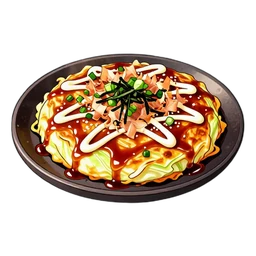
A Japanese savory pancake of wheat flour batter and shredded cabbage cooked on a griddle, then finished with sauce and toppings.
Before the first bite
- Spice
- Not spicy
- Texture
- Soft · Mixed textures
- Serving
- Individual or shared
Varies by restaurantThere is an Osaka style that mixes the ingredients into the batter and a Hiroshima style that layers them, and meat or seafood may be added. For dietary restrictions or allergies, ask the restaurant whether the food contains your trigger ingredients.
Taste and texture
Okonomiyaki cooks cabbage and flour batter with meat, seafood and other ingredients on a griddle or pan. Kansai or Osaka style mixes the ingredients into batter, while Hiroshima style stacks them over a thin base. Similar round shapes can therefore contain different internal structures.
Osaka style combines chopped cabbage, batter and egg into one pancake. Otafuku's straightforward example mixes okonomiyaki flour and water with egg, pork and vegetables. Chopped cabbage occupies much of the interior, unlike a pancake made mainly from thick flour batter.
Other batters include dashi and grated mountain yam. Just One Cookbook mixes flour, grated yam and dashi, then adds egg, tenkasu, pickled ginger and cabbage. Yam helps create a softer interior rather than a heavy, dense one; small tempura scraps add richness.
Meat placement varies too. Thin pork belly laid over the batter touches the griddle after flipping, while chopped meat mixed in sits between the cabbage. Shrimp or squid contributes seafood flavour and a springier texture.
Hiroshima style piles cabbage, bean sprouts and pork over a thin batter base, then flips it to cook the vegetables. Otafuku transfers this stack onto separately fried and sauced Chinese-style noodles, then combines it with a separately spread egg. The noodles and egg are not simply mixed into cabbage batter from the start.
Sweet-savoury okonomiyaki sauce, mayonnaise, aonori and bonito flakes finish the surface. Cabbage and batter inside work with sauce and toppings outside. Cutting through the sauce-covered top reveals either a mixed interior or distinct vegetable and noodle layers.
The cabbage-rich interior is moist and soft, while contact with the griddle browns the outside. Finely chopped cabbage distributes vegetables and batter through each piece. Grated yam can give a lighter, softer bite than a thick, flour-heavy pancake.
Draining washed cabbage helps control batter consistency: water left on the leaves can thin it. Cooking both sides also allows the centre to set rather than darkening only the exterior. Even a thick pancake needs its cabbage and egg batter to cook into a portion that can be divided.
Pork belly on the surface contributes the richness of browned meat and fat. Shrimp and squid provide springy pieces among the soft cabbage. These ingredients shape texture and savouriness rather than merely decorating the top.
Sweet-salty sauce combines with the creamy acidity and richness of mayonnaise. Bonito flakes add dried-fish aroma, aonori adds seaweed fragrance, and pickled ginger brings occasional sharp, tangy bites. Several flavours overlap through the interior and toppings.
Hiroshima style combines thin batter, cooked cabbage, fried noodles and egg in one piece. Moist vegetables contrast with springy noodles, making the layers more distinct than in the mixed style. Noodles can change thickness and portion size even when the diameter is similar.
Tokyo's monjayaki uses related griddle ingredients but substantially more dashi, producing a much runnier, separate dish. Okonomiyaki forms a mass that can be cut and moved, whereas monjayaki is scooped from the griddle with a small spatula. Batter moisture changes both its appearance and how it is eaten.
When it may suit the table
- Choose it for browned edges and a moist interior, with pork or seafood and sauce in a griddle-cooked dish.
- It suits a liking for soft, cabbage-rich batter. Osaka style distributes chopped vegetables throughout; Hiroshima style adds distinct vegetable and noodle layers.
When another path may fit better
- If you need to avoid bonito or seafood, check the dashi and filling as well as toppings. Removing fish flakes is separate from changing batter or sauce ingredients.
- Another meal may suit a craving for rice and soup. Okonomiyaki centres on batter and cabbage, and noodle-filled versions are not rice dishes.
How to order it in Korea
- Osaka style mixes cabbage and other ingredients into the batter; Hiroshima style layers them and includes noodles. If both are offered, choose according to whether you want noodles with the pancake. If the style is not named, ask whether noodles are included and which main fillings are used.
- Check whether toppings such as katsuobushi, aonori and mayonnaise can be left off or added.
Show the Korean nameName and a short phrase
Use this to point out the food or say its name. Check the food-specific ordering tips above first.
오코노미야키
Save, share or print an image
More guides in this category
Checked sources
Reviewed 2026-08-25 · Next check 2027-04-28